Kuching: Padungan Assemblyman Chong Chieng Jen has called on the Sarawak government to fine-tune the policy requiring developers to make financial contributions in lieu of constructing affordable housing units on land parcels of 10 acres or more.
He argued that imposing a flat rate across all areas in Kuching is inequitable due to the significant variations in land values.
Speaking during the debate on the Land Code (Amendment) Bill, 2025 at the Sarawak State Legislative Assembly (DUN) sitting, Chong expressed his general support for the government’s initiative to ensure that large-scale housing developments contribute meaningfully to the State’s affordable housing programme.
However, he emphasised that the implementation mechanism requires recalibration.
“Land within central Kuching, such as the area up to the third or fourth mile, can command prices of RM8 million to RM10 million per acre.
“Conversely, in areas like Moyan or Matang – which are still classified as townland – prices are significantly lower, ranging from RM300,000 to RM400,000 per acre,” Chong noted.
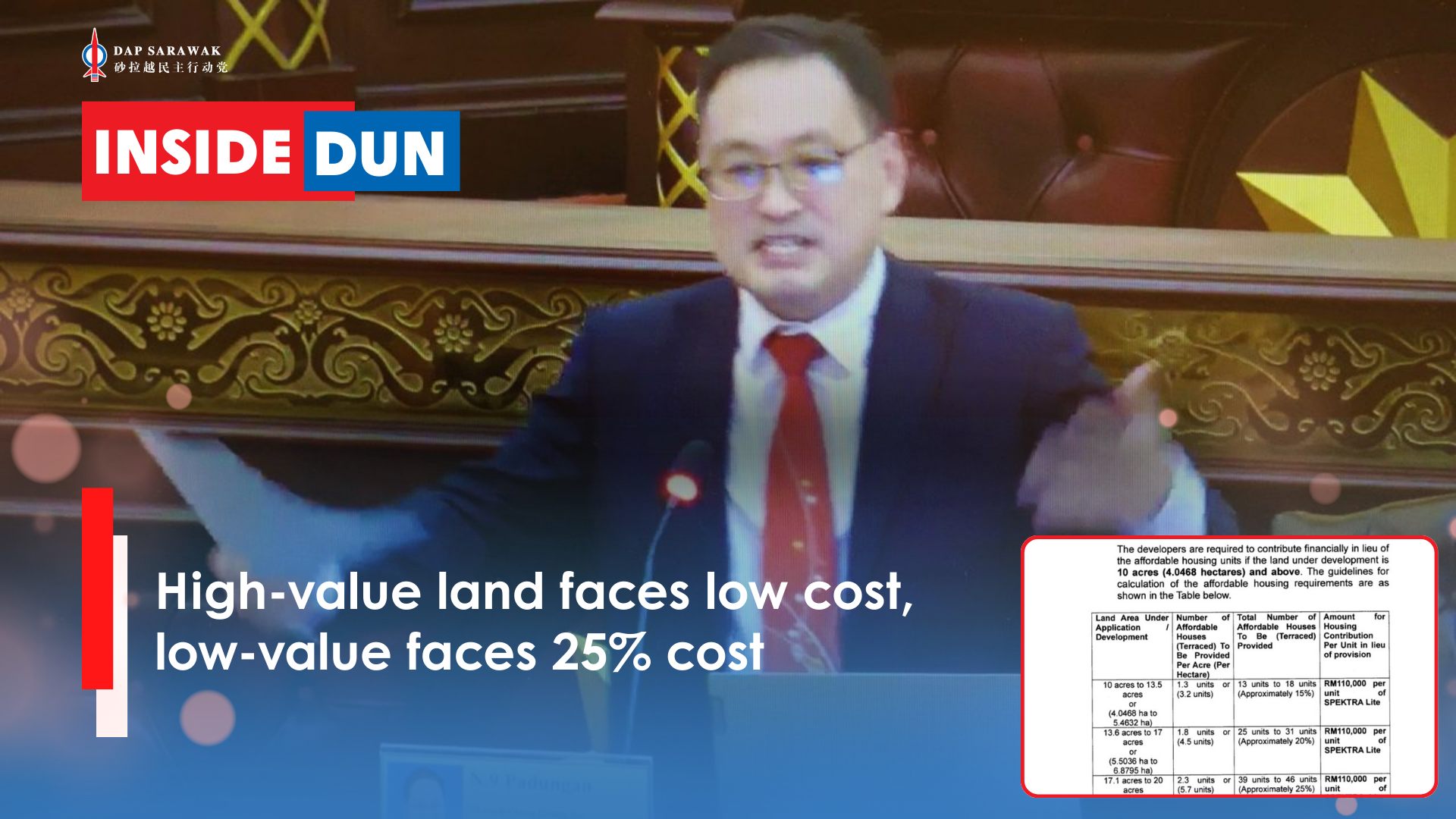
Under the current framework, developers are required to contribute the equivalent value of 1.3 affordable housing units per acre (each unit valued at RM110,000), amounting to a fixed contribution of RM130,000 per acre, regardless of land location.
Chong highlighted the resulting disparity: “For land which costs RM10 million an acre, the imposition of RM1.3 million is just about 10 percent additional cost. But for a plot of land, 10 acres costing maybe RM1.5 million, 10 acres RM50 million, to develop that, the government imposed RM1.3 million levy of housing contribution or financial contribution. It constitutes about less than two percent of the land cost.
“But for a piece of land in Moyan, Matang, which costs about RM500,000 per acre, which is RM5 million, 10 acres, the imposition of RM1.3 million on the 10 acres of development constitutes about 25 percent of the land cost,” he stressed that this disproportionate impact is unfair to developers building in more affordable areas.
He urged the government to adopt a location-based formula for calculating contributions, to ensure fairness and avoid discouraging development in Kuching’s outskirts and other cities such as Sibu.
Chong also raised concerns about the social implications of increased high-rise developments in traditionally low-rise residential areas, driven by rising land prices in urban centres.
“Developers acquiring expensive plots in city centres are often left with no choice but to construct high-rise condominiums to maintain profitability.
“Unfortunately, this leads to disruptions in long-established neighbourhoods – especially when infrastructure like waste disposal facilities are placed uncomfortably close to existing homes,” he said.
He cited an ongoing project along Hock Lee Road, where the approved development plan places a condominium waste collection area directly in front of residences on Lorong Hock Lee 2.
“The stench and daily inconvenience have become intolerable for residents,” he said, urging the Deputy Premier and the Sarawak Planning Authority (SPA) to amend the site plan and relocate the facility to a more appropriate section of the property.
Chong further advocated for the adoption of a “least disruptive” planning principle in future development approvals to balance development goals with the rights and well-being of long-term residents.
The Land Code (Amendment) Bill, 2025, tabled by Deputy Premier and Second Minister for Natural Resources and Urban Development Datuk Amar Awang Tengah Ali Hasan, aims to modernise Sarawak’s land administration framework.
The bill proposes amendments to 24 existing sections and introduces three new ones, with the objective of enhancing enforcement, streamlining planning processes, and incorporating digital innovations.
The amendments are structured into four core categories: functional and procedural updates, policy and definitional clarity, strengthened enforcement and compliance measures, and the integration of technology to ensure Sarawak’s land governance remains forward-looking and efficient.