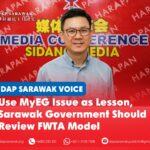
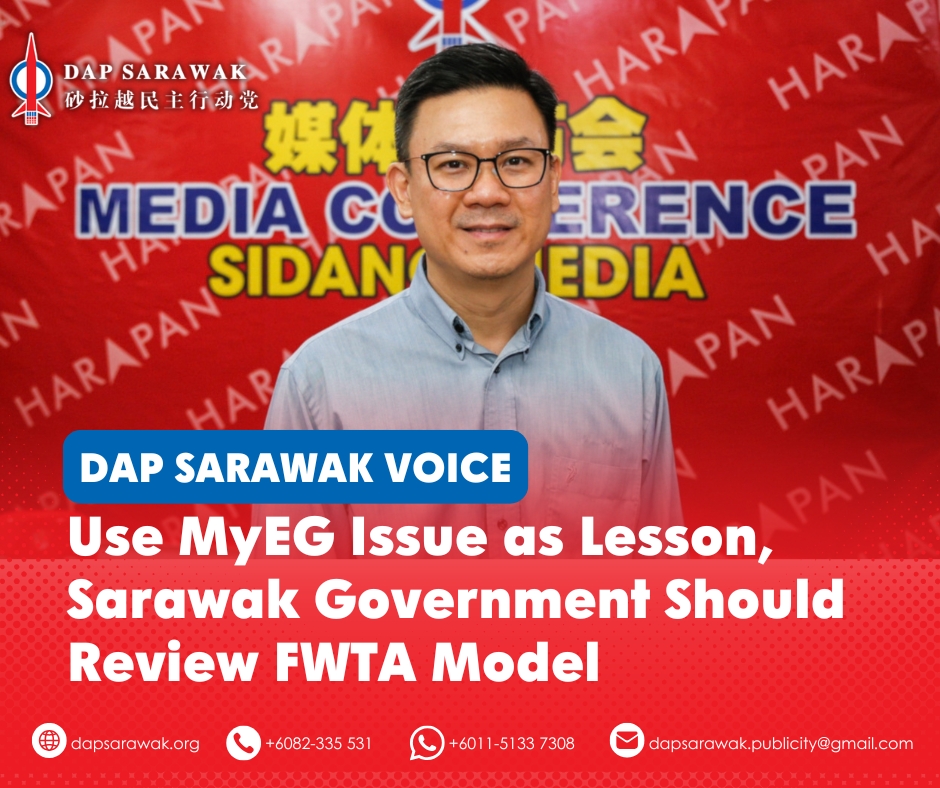
Sibu: The Sarawak Government should take lessons from the recent MyEG issue and review the overall model of private-sector involvement in the recruitment and management of foreign workers, particularly the Foreign Workers Transformation Approach (FWTA), said Sibu MP Oscar Ling Chai Yew.
Ling said the issue involving MyEG demonstrated the risks that can arise when government services, payment collection and administrative processes are entrusted to private companies without sufficient regulatory oversight, financial safeguards and mechanisms for the government to intervene when problems occur.
“The government can leverage the technology and expertise of private companies, but when a service is outsourced, the risks associated with public services cannot be outsourced as well,” he said.
Transport Minister Anthony Loke had said MyEG and Zetrix AI, acting as JPJ government revenue collection agents, failed to remit RM314 million collected on behalf of the government between May 19 and September 30 this year. Following 35 reminders and several rounds of communication, the relevant JPJ services were suspended from October 5.
Ling said similar concerns should be examined under FWTA, which involves foreign worker recruitment, approvals, work permits, Visa With Reference (VDR), medical examinations and the management of non-Sarawakian status.
He noted that SANSOLS is positioned as a centralised platform for managing and issuing relevant permits, visas and licences, making it more than an ordinary commercial electronic platform.
“It involves government administrative authority, foreign worker and employer information, as well as the collection of substantial amounts of money,” he said.
Ling said the Sarawak Government must clarify whether a comprehensive takeover and exit mechanism exists should the private service provider face financial, technical or contractual difficulties.
Under the public-private partnership (PPP) model previously explained in the State Legislative Assembly, each foreign worker is charged RM1,854 for system operations, maintenance, upgrades and related infrastructure, while the state government does not retain revenue from the payment.
He said the government should therefore review not only the fee structure, but the entire FWTA model, including the contract duration, financial safeguards, audit mechanisms, data protection and continuity of services.
“If the fee structure itself already requires a review, now is the appropriate time for the government to review the entire FWTA model, rather than merely adjusting the amount charged,” he said.
Ling stressed that reviewing FWTA does not mean rejecting digitalisation or public-private cooperation, but ensuring that ultimate responsibility for public services, administrative authority, public funds and sensitive data remains with the government.
“The biggest lesson from the MyEG issue is that the government can outsource services, but it cannot outsource responsibility.
“Since FWTA is also an important platform involving payment collection and administrative services, the Sarawak Government should take lessons from this incident,” he said.