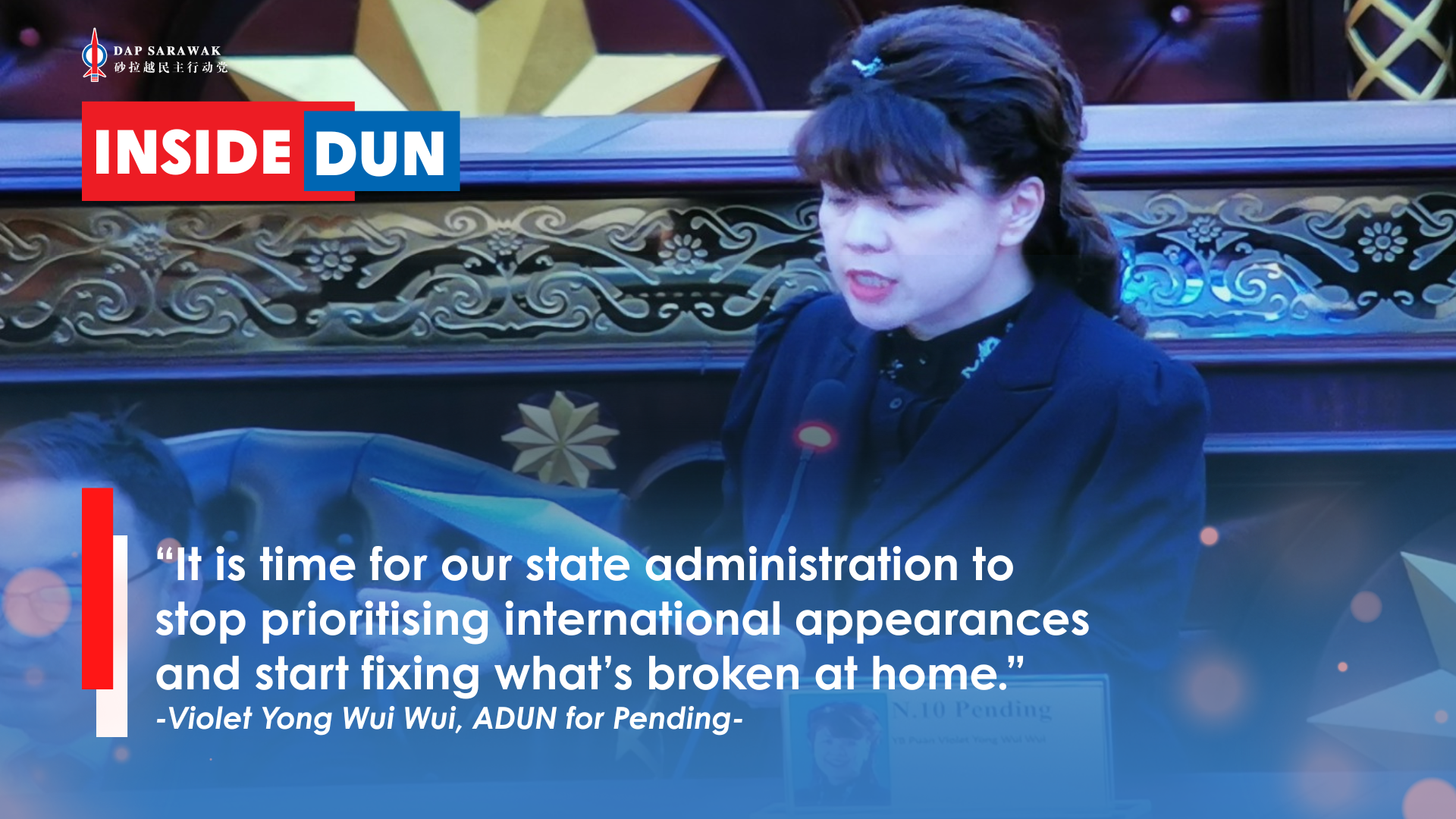
Kuching: In a fiery address during the Sarawak State Legislative Assembly (DUN) sitting on the Motion of Thanks to the Tuan Yang Terutama’s speech, Pending Assemblywoman Violet Yong Wui Wui criticised the Sarawak government for what she described as a widening gap between investment promotions and on-the-ground realities.
Here is the full text by Violet Yong’s address in DUN sitting, highlighting key issues on investment readiness and infrastructure.
Fix the basics before the brochures
Is Sarawak truly ready to attract high-value foreign investment, or are we merely putting on a show while the fundamentals remain broken?
This government has spent millions flying Ministers across the world – from Japan to United Kingdom – pitching Sarawak as a new frontier for investment. But the real test is not in the brochures or speeches. It is in what happens when those investors land here and see the ground reality.
1. Energy: Promises made, power not delivered
Sarawak often boasts of its 5,745MW in electricity generation capacity. But what matters to investors is not installed capacity. It is its availability, industrial-grade power when and where it’s needed.
The truth is hard to ignore: Sarawak Energy Berhad (SEB) is not delivering fast enough. While industrial parks are launched with ribbon-cutting ceremonies, the power needed to run factories is still “in planning” or not ready yet.
This gap is costing us real investments. Investors don’t wait three years, five years or more. They move to Johor, Penang, or Vietnam where infrastructure matches ambition.
Take Baleh Dam for example – 1,285MW hydropower project meant to strengthen our grid. Its delay only reinforces the perception that Sarawak cannot meet its own timelines. If we cannot deliver on core infrastructure, what confidence can we offer to high-value investors?
2. Land: Delayed, disjointed, and not ready
Land readiness is another bottleneck. We speak of industrial zones, but how many are truly shovel-ready, gazetted, with land titles, utilities, and road access in place?
Investors aren’t interested in potential ten years down the line. They want to start building tomorrow. But what they encounter are unclear titles, delayed approvals, and missing infrastructures.
Until we fix these on-the-ground realities, no amount of promotional missions abroad will convert interest into immediate investment.
3. Red tape and fragmented governance
The regulatory environment in Sarawak remains stuck in the past. Investors must deal with a maze of agencies where each working in silos, with no coordination, no standard timeline, and no sense of urgency.
Land approvals, environmental clearances, utility connections, import permits — each comes with its own delay. Some projects have been left hanging for over a year just for paperwork.
We don’t need just more slides presentations. What we need is a one-stop, empowered task force with the authority to cut through this bureaucracy and fast-track key investments.
4. Human capital: The missing piece
Even when infrastructure is promised, another major issue persists: that is talent.
We keep promoting advanced manufacturing, hydrogen, and green technology, but where are the skilled Sarawakians to support these industries?
Investors are forced to bring in workers from outside – which not only drives up costs but also undermines local economic benefits. Hence, without a strong, future-ready workforce, these industries will not thrive, and our people will remain spectators to progress.
5. Mega projects, minimal progress
We’ve heard of the H2biscus and H2ornbill projects since early 2022 when MOU was signed. But ask yourself: have these projects actually operational today? Last week, YAB Premier announced that these projects have yet to complete their Front End Engineering Design (FEED).
Most of these announced mega projects remain at the MoU or feasibility stage. Meanwhile, the Sarawak State Government continues to make grand announcements without fixing the delivery bottlenecks.
Tuan Speaker,
Let me be blunt: this government is not ready and investors know it.
Conclusion: Time to deliver, or step aside
Tuan Speaker,
It is time for our state administration to stop prioritising international appearances and start fixing what’s broken at home.
The government must establish a dedicated task force to align power supply timelines with investment rollouts, particularly in priority growth zones. Sarawak Energy Berhad must be held accountable through performance based targets tied to industrial readiness and not vague or shifting projections. Talking about electricity, let me enlighten this August House. Kebelakangan ini, ada yang berkata kepada saya, “Kalau ada masalah bekalan elektrik, carilah Adik Jo, dia boleh selesaikan”. Siapa itu Adik Jo? Jadi saya ingin tegaskan di Dewan yang mulia ini, harap Adik Jo dapat membantu, maka saya harap beliau mendengar suara rakyat yang saya bangkitkan di sini. Masalah ini mesti diselesaikan segera. Adik Jo boleh.
In addition, there must be an urgent review and overhaul of land approval and infrastructure processes, with clear timelines, streamlined procedures, and direct coordination between agencies to eliminate delays and duplication.
And finally, we must invest seriously in human capital, aligning technical education with future industry needs so that our people benefit directly from these investments, not just outsiders flown in to fill the gap.
Stop selling dreams. Start delivering infrastructure, skills, and results. If those in power cannot deliver, then replace them with those who can for the sake of our economy, our credibility, and our people.