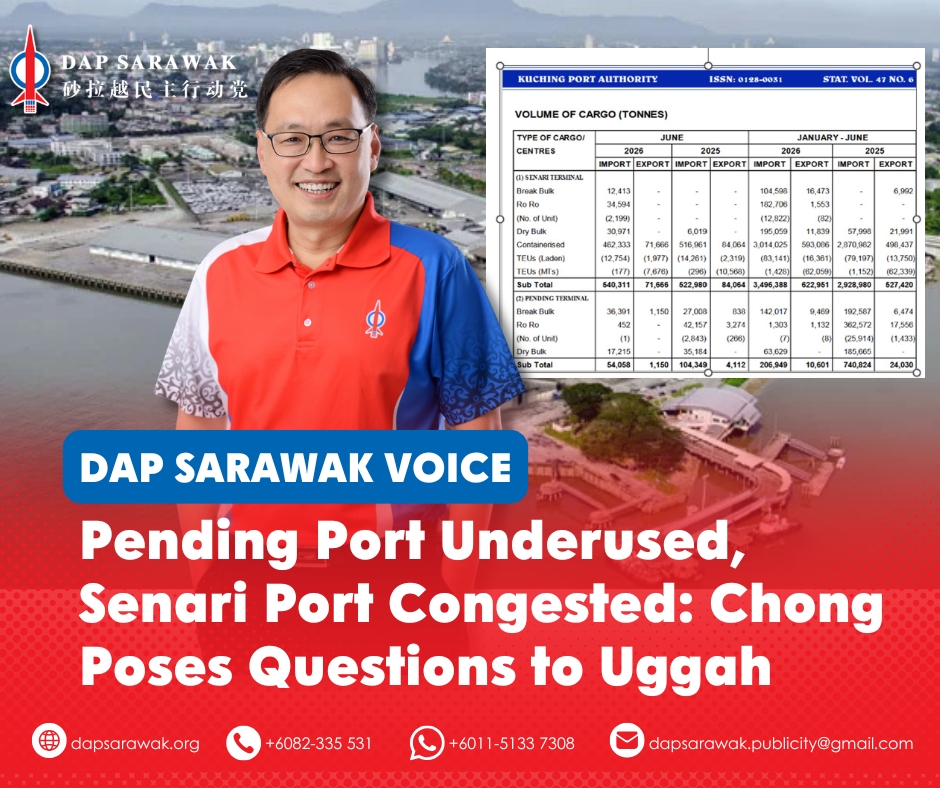
Kuching: DAP Sarawak Chairman Chong Chieng Jen has demanded answers from Deputy Premier and Minister for Infrastructure and Port Development Sarawak, Datuk Amar Douglas Uggah Embas, over the sharp decline in Pending Port’s cargo throughput and growing congestion at Senari Port.
“If the Government did actually plan in advance, there would not be congestion and delays in the discharge of cargoes at Senari Port while Pending Port is currently under-utilised,” he said in a statement.
He said the congestion over the past several months had caused ship-delivered cargo into Kuching to be delayed by an additional one to two weeks, while longer vessel waiting times had also increased logistics costs and added to Kuching’s already high shipping expenses.
Chong said Uggah’s response to his statement on “the Bridge that kills the Port” has raised more questions than it has answers.
“Douglas, in his announcement yesterday, disclosed that for the first 6 months of 2026, the Pending Port handled 217,000 tonnes of throughput (volume of cargo for import and export) and is “fully operational,” he said.
According to Chong, Pending Port now only has 1/3rd of the cargo volume compared to 2025.
“A comparison of the Pending Port’s throughput for the same first-half year of 2025 (2025 (1H)) will show that the Pending Port is now operating far from its “fully operational” capacity. In fact, for the 2026 (1H), the Pending Port only handled about 1/3rd of the throughput volume for the same period in year 2025 (1H),” he said.
The following is an extract from the Kuching Port Authority’s publication (Suara Kuport):
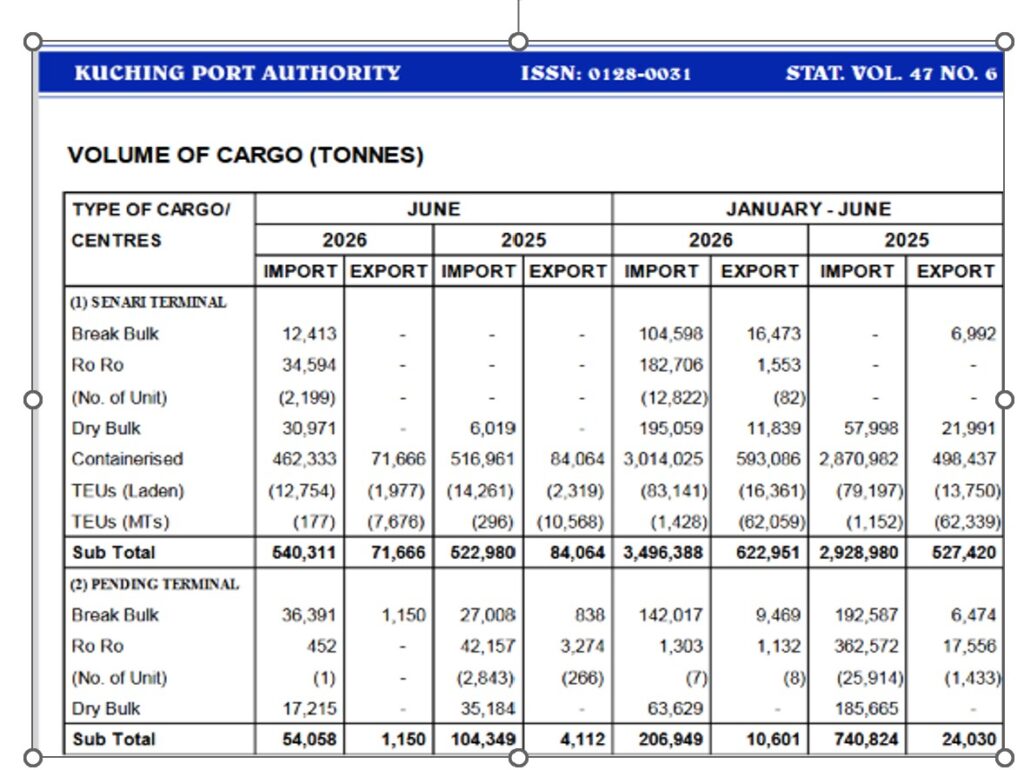
Chong said from the table published by Kuching Port Authority, it shows clearly that for 2025 (1H), Pending Port handled a total 764,800 tonnes of cargo (both import & export), whereas for 2026 (1H), the Pending Port only handled a total 217,500 tonnes of cargo (both import & export), a reduction of 547,000 tonnes of cargo handled for Pending Port.
“The most obvious reduction for Pending Port is the Ro Ro Cargo (where the cargo is vehicles). It was reduced from 380,000 tonne (27,347 units of vehicles) in 2025 (1H) to the current 2,435 tonnes (15 units of vehicles) in 2026 (1H),” he said.
Meanwhile, Chong said in the first half of 2025 (2025 (1H)), Senari Port’s throughput volume was 3,456,400 tonnes. In 2026 (1H), its throughput volume shot up to 4,119,339 tonnes, an increase of 660,000 tonnes, a major bulk of which was from the reduced throughput of Pending Port.
“Thus, it is no wonder that Senari Port faces over-congestion problem as there is a surge of cargo,” he said.
Chong therefore posed three questions to Uggah:
- How does the State Government intend to bring Pending Port back to “fully operational” capacity, given that it now handles less than 1/3rd throughput volume as compared to 2025?
- As the State Government, at the design stage of the Sejingkat Bridge back in 2021, ought to have known the impact of the bridge’s height limiting ships with an air-draft of less than 26 metres, why was Senari Port NOT extended in time to cater to the “expected” sudden surge in its throughput volume?
- Is it part of the larger scheme of things that the State Government is planning to close down the industrial parks of Pending and Bintawa, as shown in the reluctance of the State Government to renew land leases of the industrial properties in the 2 areas, and now the reduced operation of Pending Port?
He said the Government must provide clear answers on the future of Kuching’s ports and industrial zones.