
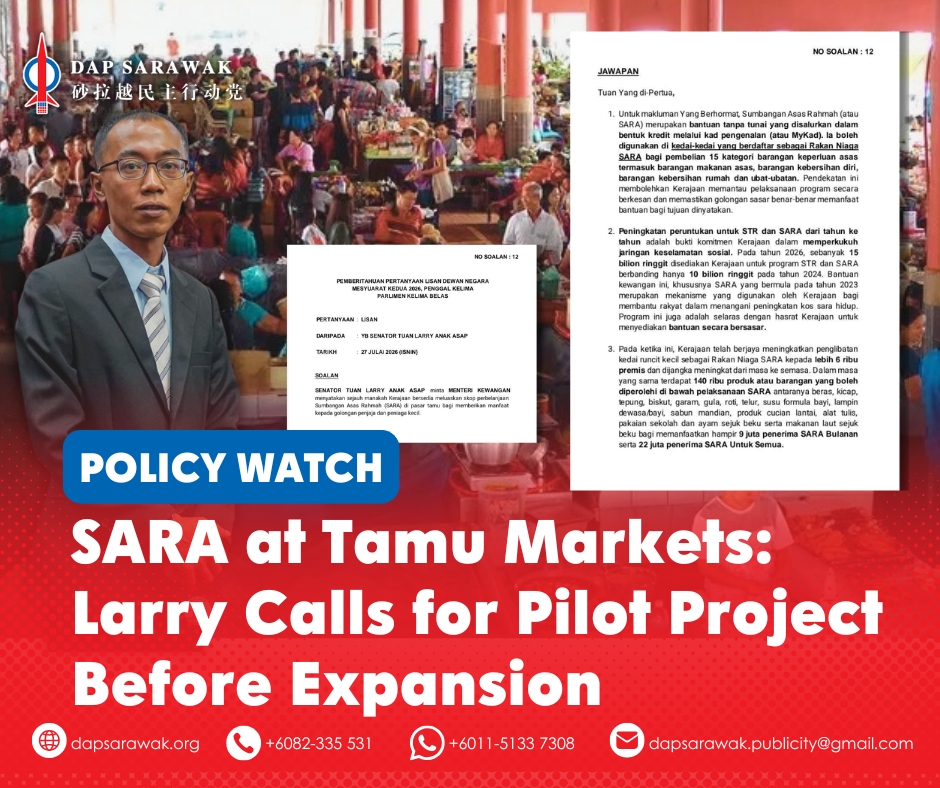
Kuching: Senator Larry Asap has called on the government to implement a pilot project lasting at least six months to test expanding Sumbangan Asas Rahmah (SARA) spending at tamu markets before rolling it out nationwide.
He said the approach was important to identify the strengths and weaknesses of the implementation mechanism, while also assessing its impact on the income of hawkers and small traders at the grassroots level.
The proposal follows his question to the Finance Minister on 27 July 2026, during the Second Meeting of the Fifth Session of the 15th Parliament, on the government’s readiness to expand the scope of SARA spending to tamu markets.
In its response, the Ministry of Finance said the use of SARA QR code payments at tamu and farmers’ markets was still under study.
The ministry also stated that if the mechanism was found to be sustainable, its implementation would be announced in Budget 2027.
Larry said the Ministry of Finance should work closely with local authorities (PBT) and District Offices to implement the pilot project.
Among the proposed mechanisms are the registration and licensing of participating hawkers through local authorities, obtaining business licences through District Offices, opening current accounts for business purposes, and having the Ministry of Finance issue QR codes for SARA transactions.
He proposed that the pilot project cover Tamu markets in urban, semi-urban, and rural areas to assess its effectiveness across different settings.
“The income data collected from hawkers at these tamu markets is important in providing a clear picture of how far the policy succeeds in increasing their household income,” he said.
According to Larry, concrete data would also be needed to determine whether the programme could help participants move above the Poverty Line Income (PGK).
He hoped the proposal would be considered in Budget 2027 as an initial step towards expanding SARA’s benefits to grassroots communities.
“Let us start with this small step. For information, the allocation for STR and SARA alone reached RM15 billion in 2026,” he said.
He added that the proposed expansion of SARA aimed to increase household incomes and help people break free from the cycle of poverty.