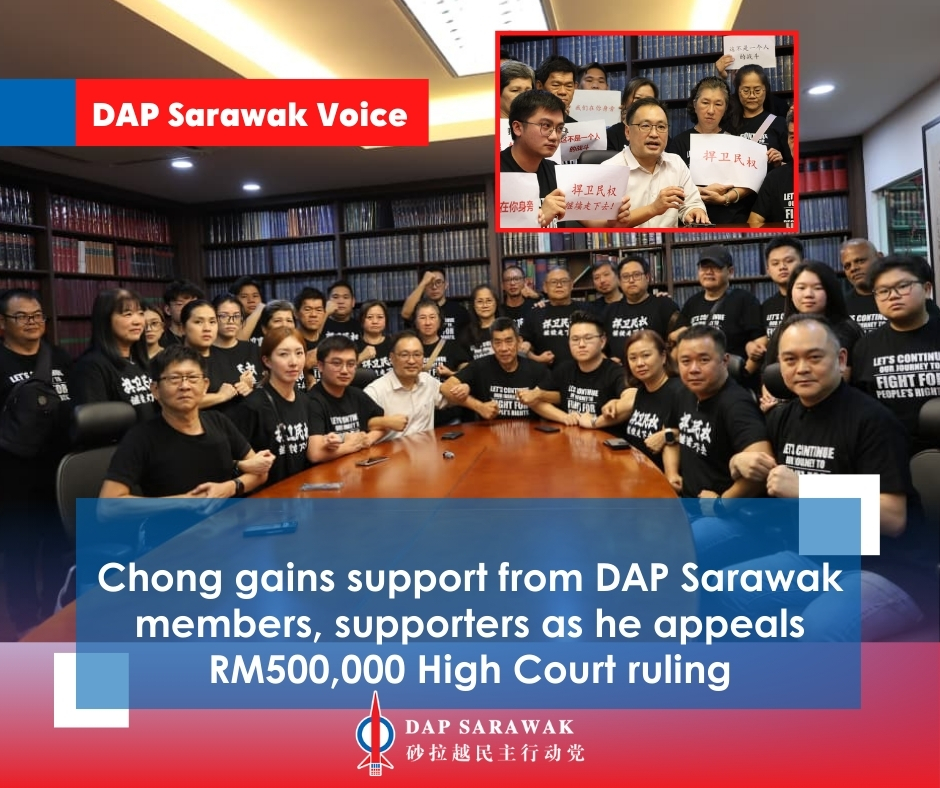
Kuching: DAP Sarawak chairman Chong Chieng Jen has received strong backing from party members and supporters in Kuching as he prepares to appeal a High Court ruling ordering him to pay RM500,000 in damages and costs to Deputy Premier Datuk Amar Dr Sim Kui Hian.
In a joint statement issued after a solidarity gathering titled “Defending Free Speech, Standing with Chong Chieng Jen”, the group said they respected Malaysia’s judicial system and acknowledged that legal disputes must be resolved through established legal processes.
However, they said the appeal stage offers a significant opportunity to review relevant legal and constitutional principles at a higher level of the judiciary.
“We maintain that this case does not arise from a private dispute, but from issues of public governance and livelihood during the Movement Control Order (MCO) in 2020.
“At that time, society faced unprecedented challenges, with many families experiencing severe economic hardship. The implementation and distribution of government assistance naturally became a matter of deep public concern,” the statement said.
The group said Chong, in his capacity as an MP and opposition leader, had raised questions on the execution of government aid during the pandemic as part of his constitutional duty to scrutinise government actions and represent the people.
They stressed that public accountability, transparent governance and the right to raise reasonable questions are fundamental pillars of a democratic system.
“We also note that during a period when many were facing food insecurity and livelihood pressures, society holds higher expectations of public office holders, particularly those within the executive branch.
“The public expects ministers to prioritise coordination and problem-solving, rather than allowing issues of public accountability to escalate into political or legal contention,” they said.
They said that, at a time when people urgently needed food and assistance, any action that risks diverting attention or deepening societal divisions does not align with the realities faced by the rakyat.
“We must emphasise that by wearing this attire as a group, it symbolises our collective effort and shared stance in continuing to defend the people’s fundamental rights. This also reflects our continued commitment to democratic values and public accountability,” they said.
The group emphasised that their support for Chong’s appeal was not directed against the judiciary or any court decision.
While respecting the role of the courts, they said a mature democracy must preserve space for elected representatives to exercise reasonable oversight and speak on matters of public interest.
They reaffirmed their commitment to addressing livelihood issues, upholding accountability and advocating, through lawful means, for the rights and welfare of Sarawakians.
Meanwhile, Chong thanked party members and supporters who gathered in solidarity, saying their presence strengthened his resolve to continue serving the people.
“I want to assure Sarawakians that in any democracy, opposition is essential. A democracy without opposition is tyranny,” he said, reaffirming his commitment to defend what he described as the people’s rights.
He also expressed appreciation to long-serving party members whose continued support had encouraged him throughout his political journey.
Chong confirmed he would appeal the High Court decision, describing the case as stemming from his criticism of what he viewed as an unfair state policy during the MCO.
Reflecting on his political career since first being elected as a state assemblyman in 2006, Chong cited several legal challenges, including an election petition, the police seizure of his laptop, and prosecution over the Bersih 4.0 rally — all of which were eventually resolved in his favour.
He also referred to the long-running “Black Hole” trust fund case involving an alleged RM11 billion, which has taken more than a decade and is currently under appeal.
“Being in the opposition in Sarawak is not easy,” he said, noting that opposition leaders often face political, economic and legal pressures.