
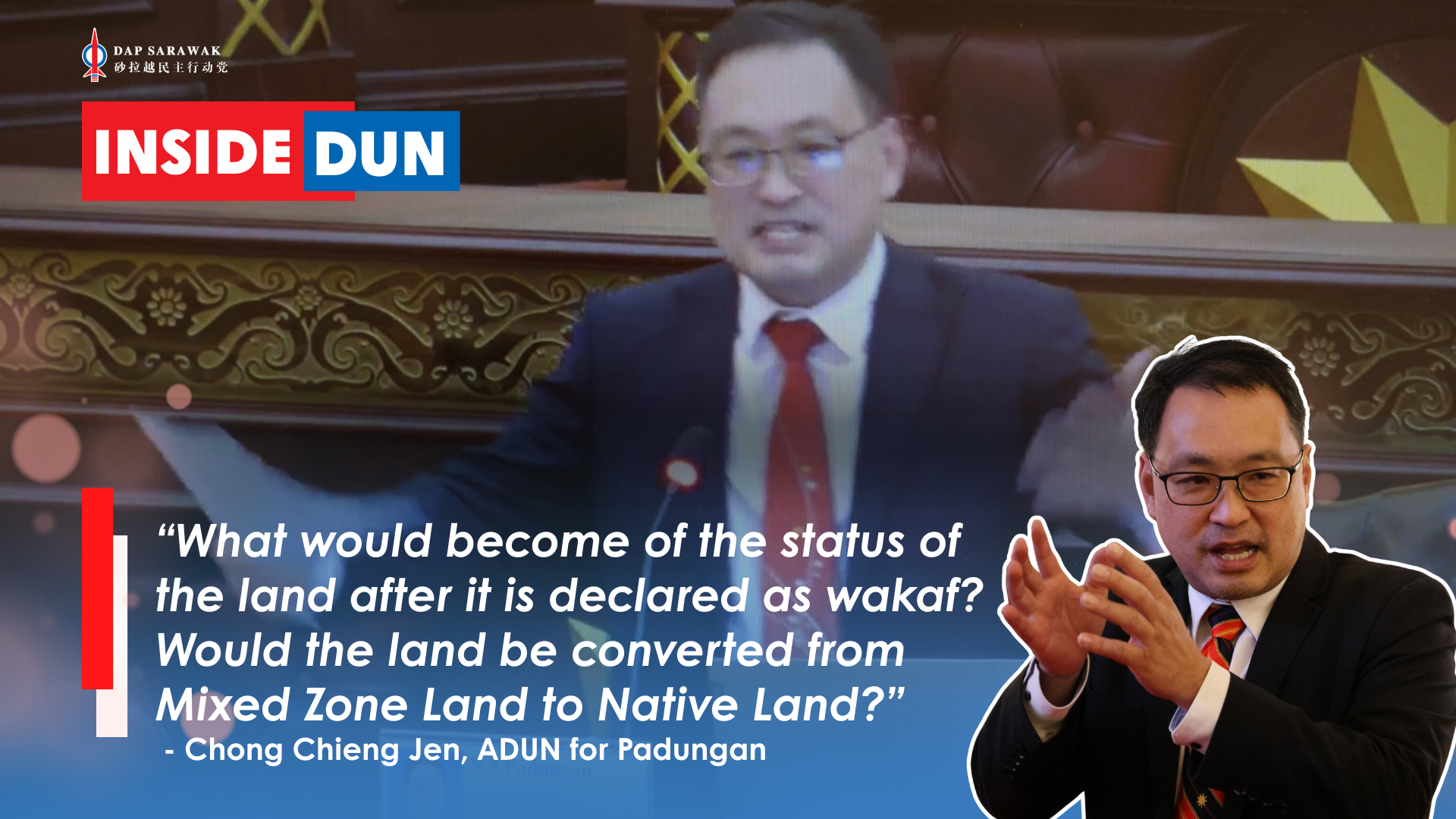
Kuching: The Land Code (Amendment) Bill, 2025 has sparked significant concern from the Democratic Action Party (DAP) Sarawak Chairman, Chong Chieng Jen, who argues that introducing the Islamic concept of Wakaf (endowment) poses serious implications for the future and for generations to come.
Debating the Bill tabled by Deputy Premier Datuk Amar Awang Tengah Ali Hasan in the State Legislative Assembly (DUN) sitting yesterday, Chong, who is also the Padungan assemblyman, focused on Clause 9 of the Amendment Bill seeks to import the concept of “Wakaf or endowment” into the Land Code.
It reads as follows:
171A: (1) Any person who has rights and interests in any land may lodge an application to declare such land as wakaf or endowment, in accordance with the rules made under section 213, subject to the conditions or requirements in any written law.
(2) In the case of land identified as wakaf under the Majlis Islam Sarawak Ordinance, 2001 [Cap.41], the application to declare such land as wakaf may be lodged by the Majlis Islam Sarawak.
(3) Subsection (1) shall apply to any endowment made under any other religion having the same concept of wakaf, which is to be regulated by the relevant law and body identified under such religion.
Four core concerns raised
During the debate, Chong raised four major concerns:
1. Threat to Sarawak’s secular legal foundation
For the first time in the history of Sarawak, the Government is seeking to import religious elements into the Sarawak Land Code, which is a law of general application to all persons professing different religions.
This goes against the very fundamental constitutional framework of Sarawak, that Sarawak is a secular state.
As opposed to the Federal Constitution, which provides that “Islam is the religion of the Federation”, the Constitution of the State of Sarawak does not provide any religion to be the religion of the State. As such, we in Sarawak do not have an official religion. All the more, we should keep religion out of laws which have a general application to all the people, of which the Sarawak Land Code is one.
So far, the State Government has kept religion away from the general administration of the government, and that is good. It helps to preserve the racial harmony that we enjoy thus far.
By introducing the concept of “Wakaf” into the Land Code today, the Government is setting the precedent of Islamic doctrine and religious ideology to be incorporated into a law of general application to all. This will have a serious implication in the future and for generations to come.
I have no problem with any religion and its teaching, be it Islam, Christianity or Buddhism. All religions teach us to fear the divine power and to do good. But I am also a firm believer that religious ideologies should be kept away from the realms of law and governance. The racial disharmony and tension in West Malaysia are due, to a large extent, to the fact that the 2, government and religion, have intertwined too much. I loathe to see the day that Sarawak goes down that path.
2. Lack of clarity towards and undefined concepts
The word ‘wakaf’ is not defined in the Land Code. To our Muslim friends, it may be a common word, but to the non-Muslims, ‘wakaf’ is not so widely understood. Even before I stand to debate, I have to refer to the Majlis Islam Sarawak Ordinance, 2001, to ascertain the definition of wakaf.
In the Ordinance, there are 2 types of “wakaf”, namely:
“wakaf am” means a dedication in perpetuity of the capital and income of property for religious or charitable purposes recognised by Islamic Law and the property so dedicated; and
“wakaf khas” means a dedication in perpetuity, or for a limited period, of the capital of property for religious or charitable purposes recognised by Islamic Law and the property so dedicated, the benefit and income of the property being given to specified persons or for purposes prescribed in the wakaf.
The key difference is that one is a dedication in perpetuity, and one is a dedication in perpetuity or a limited period. For further clarification and determination in the interpretation of the word wakaf in the Land Code, one might have to seek the interpretation from the Majlis Islam Sarawak or the Lembaga Fatwa, as provided in the Majlis Islam Sarawak Ordinance.
3. Legal ambiguity
What would become of the status of the land after it is declared as wakaf? Would the land be converted from “Mixed Zone Land” to “Native Land”? Can the wakaf land be developed or sold, and the proceeds be kept by the trustee for the charitable purpose for which the land was dedicated?
4. Risk of legal conflicts and social tension
In the event that there is a competing claim over a parcel of land declared as wakaf and one of the claimants is not a Muslim, would Islamic Law be applicable or civil law? Would the challenge by the non-Muslim on the declaration of wakaf be then regarded as a challenge against the religion? There may even be an issue of which Court, the Civil Court or the Shariah Court, to determine the issue.
Such conflict in the application of Civil Law and Islamic Law has not only created much legal argument but at times it can be a very divisive issue in a multi-racial and multi-religious society like Sarawak.
Under the current Land Code, if anyone wishes to donate his/or her land for charitable purposes or any religious purpose, ie, to build a mosque, masjid, a church or temple, it can be done. Their land can be transferred to and registered in the names of the relevant organisation for such purposes. Special conditions on the land use can be endorsed on the title deeds for such purposes. There is thus no need to amend and introduce the religious concept into our Land Code via this amendment.
Therefore, Chong proposed that Clause 9 of the Amendment Bill and part of Clause 14 seeking to introduce the new sub-section (1)(n) relating to regulating the procedure for wakaf or endowment be removed from the Amendment Bill.
“The Sarawak Land Code is a secular law and should remain so. Any attempt to import religious elements into this piece of secular legislation will go against the original intention of our State’s founding fathers and the spirit of MA63.
“On the issue of administering the creation and management of Wakaf, rather than amending the Sarawak Land Code, it will be more proper that the State Government introduce a new bill regulating all Wakaf matters, and such a bill can be modelled after India’s Waqf Act 1995, amended in 2025,” he said.