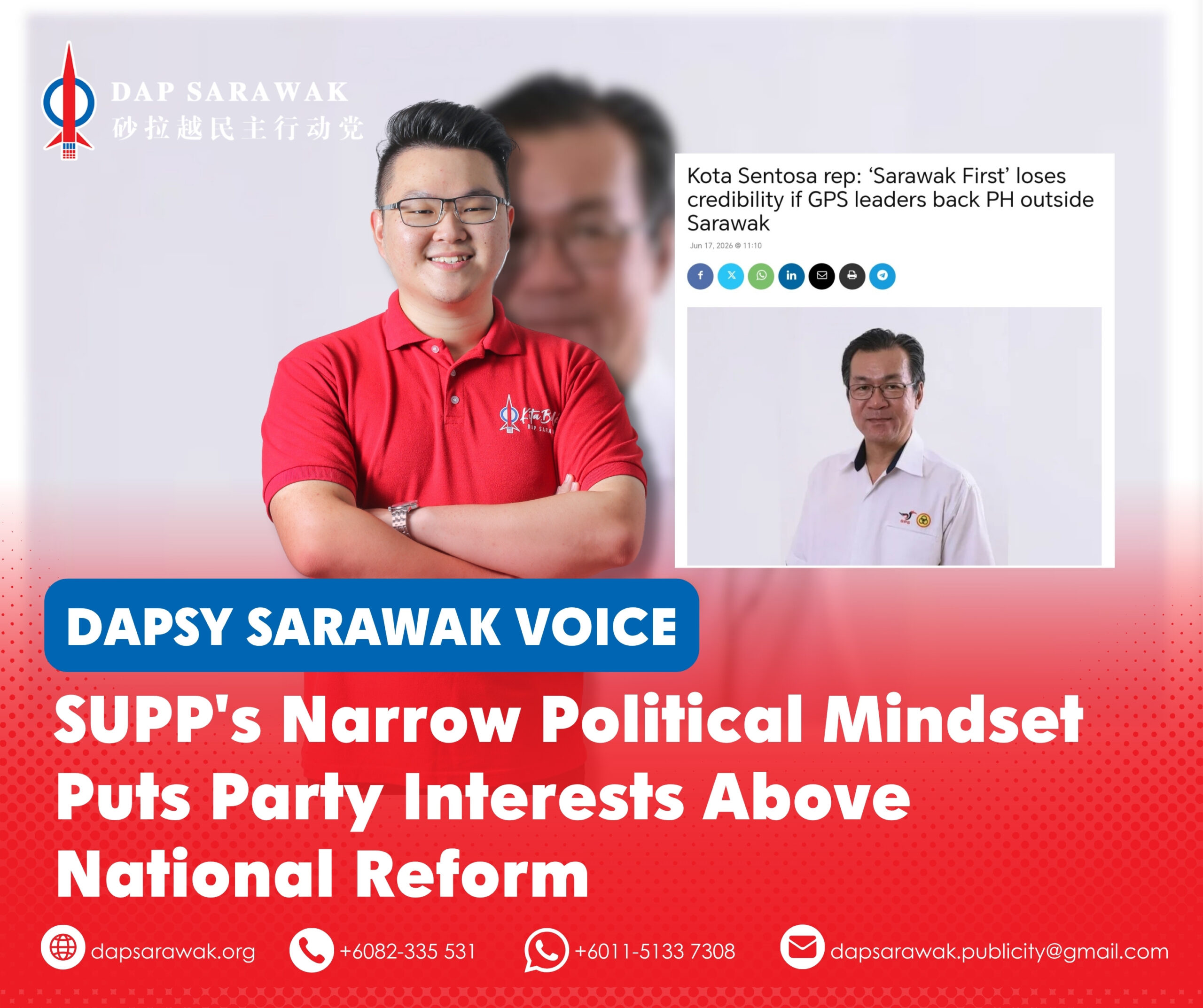
SUPP’s Narrow Political Mindset Puts Party Interests Above National Reform
Kuchig: I am disappointed by the remarks made by Kota Sentosa assemblyman Wilfred Yap regarding Progressive Democratic Party (PDP) president Datuk Seri Tiong King Sing’s decision to campaign for Pakatan Harapan (PH) in Johor. His criticism not only lacks substance, but also exposes SUPP’s narrow political mindset and its failure to articulate a clear position on the future direction of national politics.
In my view, Datuk Seri Tiong King Sing’s presence in Johor is a demonstration of support for a moderate, inclusive and reform-oriented political agenda at the national level. This reflects a broader political vision that prioritises the future of the country rather than narrow party interests.
In contrast, SUPP has consistently failed to take a firm stand against racial extremism and conservative political forces. On many critical national issues, it appears more comfortable attacking reformist forces than confronting those who threaten Malaysia’s multicultural and moderate foundations.
The Johor and Negeri Sembilan state elections are not ordinary elections. They represent a contest between two very different political directions for Malaysia.
On one side is Pakatan Harapan, which continues to advocate institutional reforms, good governance, moderation and a multiracial political approach. On the other side are Barisan Nasional elements seeking political restoration and PAS, a party widely associated with increasingly conservative and divisive political narratives.
Datuk Seri Tiong chose to support PH because he recognises the importance of sustaining the reform agenda. Instead of appreciating this commitment, SUPP has chosen to attack those who support reform.
This raises important questions. Does SUPP support the return of Barisan Nasional as the dominant force in national politics? Would SUPP be comfortable with the increasing calls for former Prime Minister Najib Razak to return to the political arena?
The Malaysian public understands that if Barisan Nasional regains overwhelming political influence, the pressure to rehabilitate figures associated with past scandals will only grow stronger. SUPP owes the people an honest answer on where it stands.
Likewise, SUPP has remained largely silent on the increasingly conservative agenda promoted by PAS over the years. From issues affecting non-Muslim rights to rhetoric that deepens social divisions, these developments have generated concern among many Malaysians.
Yet SUPP appears more interested in criticising supporters of moderation and reform than clearly opposing these extreme tendencies. Such selective silence is itself a political position.
I also find it troubling that whenever leaders from UMNO Youth made statements perceived as detrimental to the interests of the Chinese community, SUPP was rarely at the forefront in defending those concerns. Today, when Malaysians are faced with a choice between moderation and extremism, reform and regression, SUPP once again refuses to stand firmly on the side of moderation and reform.
SUPP frequently claims to represent and defend the interests of the Chinese community. However, when confronted with a clear choice between a moderate and reform-oriented political path and one increasingly influenced by conservative and racial politics, it remains unwilling to take a principled stand.
To me, true political leadership is not about calculating short-term political gains. It is about making the right decision when the nation faces important crossroads.
Datuk Seri Tiong’s support for Pakatan Harapan is aimed at ensuring Malaysia continues on a path of reform, moderation and inclusivity.
SUPP’s attack on him only reinforces the perception that the party is more concerned with protecting its political interests than advancing the country’s future.
History will ultimately judge those who stood for reform, moderation and inclusivity. Likewise, it will remember those who remained silent in the face of extremism and those who placed narrow political interests above the nation’s future.
George Lam
DAPSY Sarawak Secretary
19 June 2026