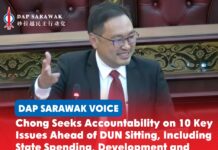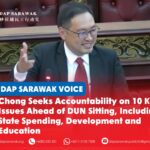

Kuching: Questions have been raised over the management of MBKS’s financial surplus, with DAPSY Sarawak Organising Secretary Chong Hong Hien arguing that the council’s reported surplus of approximately RM305.5 million should be reflected in the quality of public services and infrastructure provided to residents.
Responding to recent remarks by MBKS Mayor Dato Wee Hong Seng on the council’s financial position, Chong said the mayor’s explanation that the surplus resulted from the consolidation of various fiscal revenues and expenditures did not change the fundamental fact that MBKS recorded revenue exceeding expenditure.
“Regardless of how the Mayor chooses to explain it, the MBKS budget clearly shows that revenue exceeds expenditure, resulting in a budget surplus,” Chong said in a statement.
He said the key issue raised by DAP Sarawak Chairman Chong Chieng Jen was whether MBKS had delivered public services commensurate with its financial capacity.
Chong argued that concerns over service delivery within MBKS’s jurisdiction have been highlighted by leaders of the Sarawak United People’s Party (SUPP), who recently acknowledged that areas such as Pending continue to face development shortcomings.
“From Deputy Premier Dr. Sim Kui Hian, to MPP Chairman Tan Kai, and even MBKS Mayor Wee Hong Seng himself, they have recently been repeatedly promoting the narrative that ‘Pending lacks development.’
“Such statements in themselves are proof that many shortcomings in development and public services still exist within MBKS’s jurisdiction,” he said.
He added that development cannot be measured solely by the number of ART stations built or green energy initiatives implemented.
“At its core, development is about whether the people’s basic living environment is properly maintained – whether roads are in good condition, streetlights function, drains are well maintained, and basic infrastructure is adequately provided,” he said.
He also criticised what he described as the mayor’s tendency to respond to concerns raised by opposition leaders through public criticism rather than addressing the issues raised.
According to Chong, Wee has on numerous occasions cited a lack of funding as the reason for the council’s inability to resolve municipal problems and has even publicly called on the opposition to help identify funding sources.
However, Chong said MBKS’s own financial reports indicate that the council currently holds a surplus of approximately RM305.5 million.
“If that is the case, what exactly does the Mayor mean when he says there is ‘no money’?” he asked.
“Is RM305.5 million still insufficient to improve roads, repair drains, and upgrade public facilities? Or is the real shortage not one of funds but of political will and determination to solve problems?”
While acknowledging that maintaining adequate reserves is a prudent financial practice for any local authority, Chong argued that reserve funds should not be used to justify delays in addressing pressing infrastructure and public service issues.
“Reserve funds are meant to prepare for future risks, not to rationalise inaction today,” he said.
Chong stressed that the primary role of a city council is to provide quality public services and improve residents’ quality of life, rather than focusing on accumulating financial surpluses.
“The success of a local authority should not be measured by how much money it has on paper, but by whether the lives of the people have improved as a result,” he said.
Drawing comparisons with international examples, Chong cited London, where local authorities continue to prioritise public services and infrastructure investment despite fiscal pressures.
He said London’s reputation as one of the world’s most liveable and economically vibrant cities demonstrates that effective governance is measured by how well public resources are translated into tangible benefits for residents.
Chong added that while recording a surplus is positive, generating profits has never been the mission of local government.
“The true responsibility of a city council is to ensure that taxpayers’ contributions are translated into better roads, improved public facilities, and higher-quality municipal services,” he said.
He urged Wee, as mayor, to focus on improving public services and infrastructure rather than defending the existence of the surplus or criticising the opposition.
“What the people truly expect is not for the Mayor to continue defending the existence of a surplus but to see that surplus put to good use so that residents can genuinely experience better municipal services,” he said.