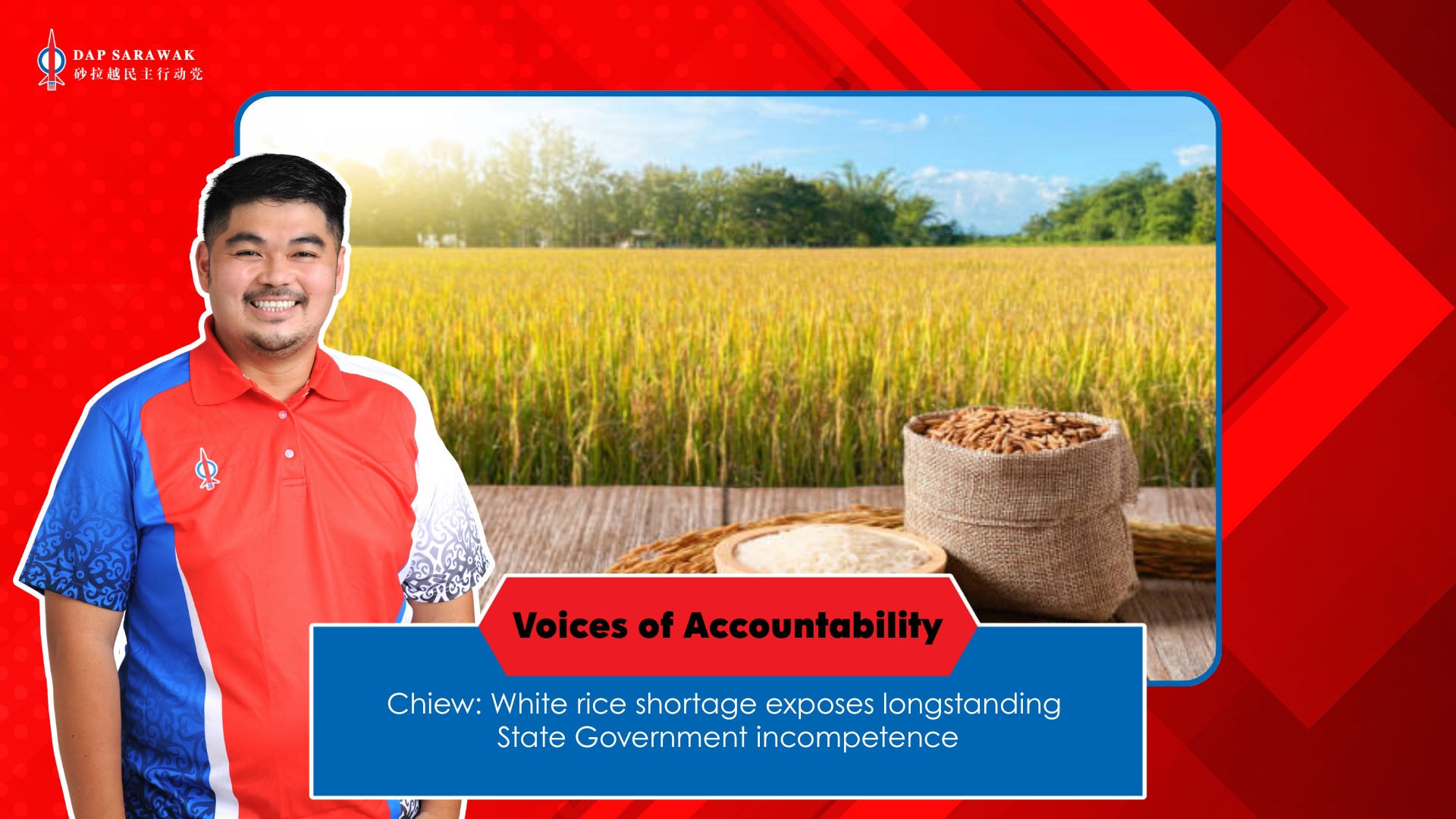
Bintulu: In light of recent concerns about a potential white rice shortage in Sarawak, Democratic Action Party (DAP) Bintulu Branch Chairman Chiew Chan Yew has pointed out that the development of Sarawak’s food security has been delayed for many years, calling the current supply strain a foreseeable consequence of long-term policy inaction.
Chiew said that while the Sarawak government has only recently sounded the alarm over rice supply disruptions, the root issue lies in the state’s failure to boost its agricultural self-sufficiency, which has stagnated for decades.
“We are not lacking land, water resources, or farmers. What we are lacking is a government with responsibility and vision,” he stated.
Highlighting Sarawak’s natural advantages, including vast arable land and a favorable climate, Chiew argued that the persistent underdevelopment of the sector is due to a lack of political will rather than limited resources.
Referencing historical efforts under the Brooke administration dating back to the 1840s, Chiew noted that rice cultivation had once been actively promoted with infrastructure and incentives in place.
“More than 150 years ago, we already recognised the importance of self-sufficiency. The real question is, after more than a century and a half, why does Sarawak still heavily rely on rice imports?” he asked.
According to official data, Sarawak’s current white rice self-sufficiency rate is only 32%, with a target of reaching 60%. Chiew noted that this target was set years ago, yet progress has remained slow, policies frequently change, and actual results have been minimal.
“Whenever the topic of food crises arises, the government loves to stress, ‘What if exporting countries stop exports?’ But what about our local food production?
“Sarawak’s agriculture doesn’t fail because it is impossible. It fails because the government has never taken it seriously,” he said.
Calling for immediate action, Chiew urged the Sarawak government to prioritise food security by implementing effective land-use policies, supporting farmers, and building a resilient agricultural supply chain.
“Food security is about basic survival. It is not an election slogan, nor should it be another tired political gimmick trotted out during campaign season,” he said.