Sibu: Sibu MP’s Special Assistant and DAPSY Sarawak Vice Chief Irene Wong Lee Ting has urged the Election Commission (EC) to review the proposed electoral boundaries in the Sibu parliamentary constituency, calling for a more practical and reasonable arrangement that reflects local communities, population distribution and administrative needs.
Wong said the EC’s public display and representation period, which runs from 1 to 30 September, provides residents with an important opportunity to express their views.
Over the past month, she and the P.212 Sibu Service Centre team have collected feedback and signatures from residents, with community representatives also prepared to present their concerns to the EC through the proper procedures.
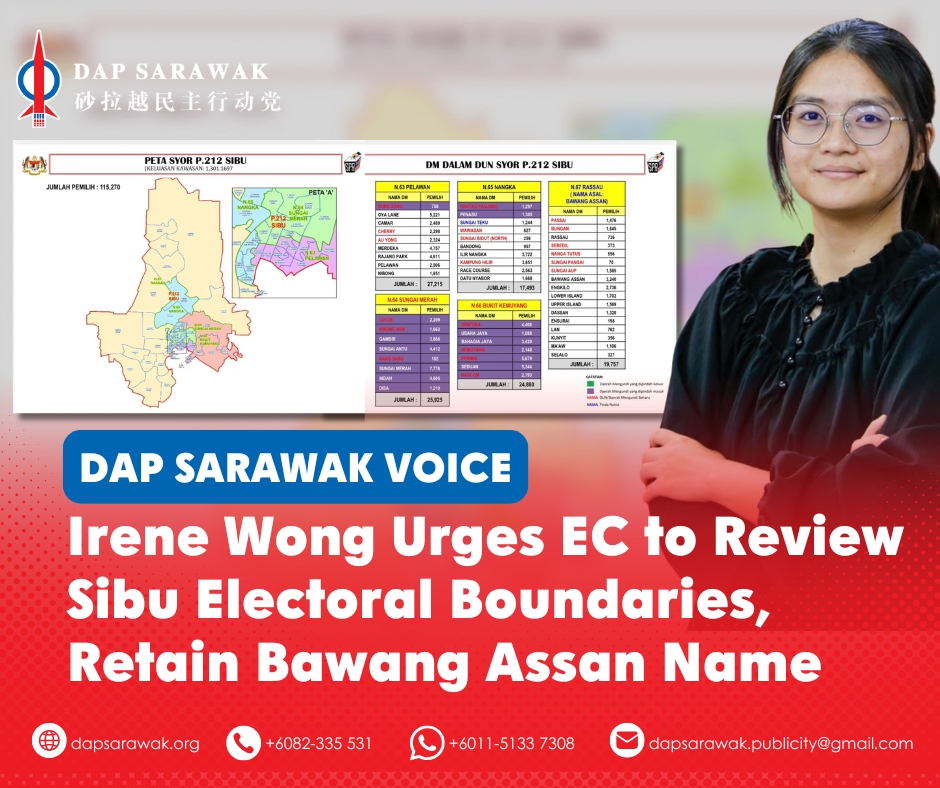
Under the proposed redelineation, the number of voters in the Sibu parliamentary constituency will increase from 110,857 to 115,270, while the number of state constituencies will rise from three to five: Pelawan, Sungai Merah, Nangka, Bukit Kemuyang, and Rassau. The number of polling districts will also increase from 32 to 51.
Wong said the review should go beyond creating additional state seats and include a comprehensive assessment of the existing urban constituencies.
She pointed out that Pelawan has 27,215 voters, Sungai Merah 25,925 and Nangka 17,493, highlighting the differences in voter numbers that warrant further consideration.
“EC should take into account population distribution, geographical conditions, transportation and rural factors while ensuring fair representation.
“Existing urban constituencies should be reviewed as a whole, rather than simply adjusting boundaries, to reflect Sibu’s population growth and future development,” she said.
Wong also raised concerns over the proposed boundaries of the new Bukit Kemuyang constituency, which would include Sentosa and Usaha Jaya.
“The proposed extension and changes in direction raised questions about the rationale behind the arrangement, and EC need to clarify the population, geographical and administrative factors involved,” she said.
On the proposed renaming of Bawang Assan to Rassau, Wong urged the EC to retain the original name, which has been used since 1987 and carries historical and local significance.
She noted that Bawang Assan has 3,240 voters, making it the largest of the 17 polling districts in the area, while Rassau has only 736 voters.
“Why should the name Bawang Assan, which has been used for many years and is familiar to local residents, be changed to Rassau in this boundary review? Looking at the local polling districts, Rassau is also not the main polling centre in the constituency,” she said.
She also questioned why areas such as Rassau, Sebedil and Bungan are politically represented under Sibu despite having administrative and government service links with Mukah.
“Residents in these areas deal with Mukah’s administrative agencies for welfare, assistance and other services, highlighting the need to review the existing arrangement,” she said.
Wong said electoral boundaries should reflect residents’ actual administrative and community connections, including where they access government services and how easily they can reach their elected representatives.
She stressed that the review should consider the practical needs of residents rather than simply redrawing boundaries on a map.
She further highlighted the administrative challenges faced by Bawang Assan, which covers several local authorities, including Majlis Daerah Matu dan Daro, Majlis Daerah Luar Bandar Sibu and Sibu Municipal Council.
She said covering different administrative areas could complicate coordination with government departments and make it more challenging for elected representatives to address local issues.
Wong also called for a review of the proposal to remove Penasu from Bawang Assan, citing its geographic ties to the area and the need to consider accessibility for residents and elected representatives.
She also highlighted Sungai Pangai, which has only 70 voters, urging the EC to review its location, voter numbers and accessibility to ensure residents can exercise their voting rights conveniently.
Wong stressed that the boundary review should ensure reasonable representation, stronger community connections and more accessible constituency services.
She urged the EC to carefully consider residents’ feedback before finalising the proposed changes, particularly those involving Pelawan, Sungai Merah, Nangka, Bukit Kemuyang and Bawang Assan/Rassau.