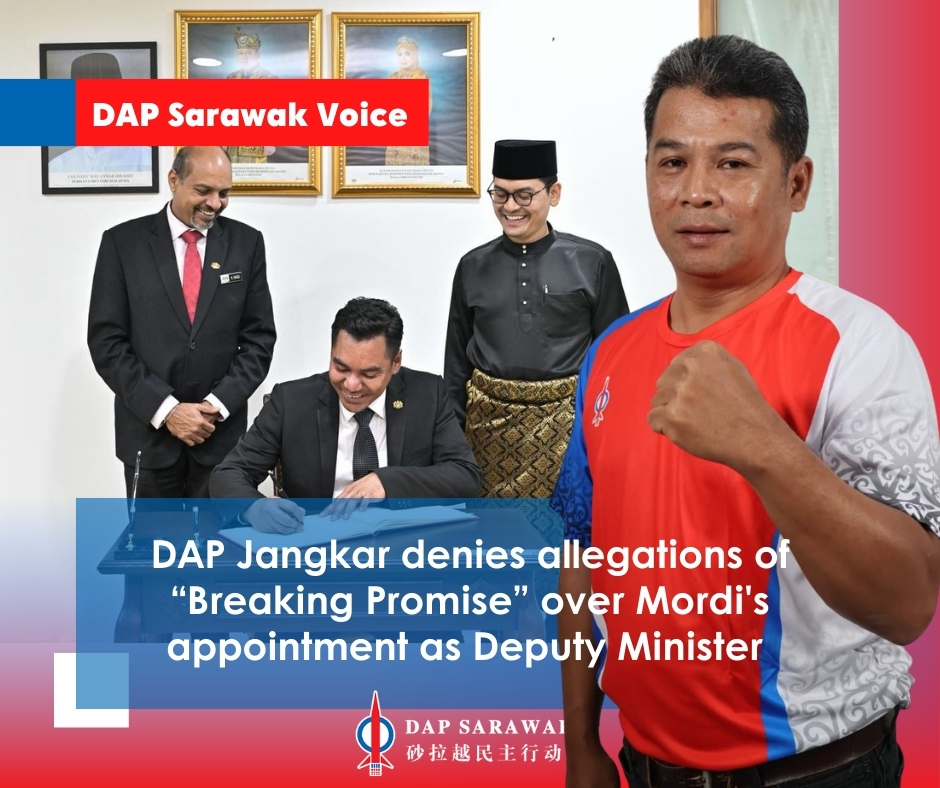
Lundu: DAP Sarawak Jangkar branch has denied claims that the party broke its promise following the appointment of Mordi Bimol as Deputy Minister of Youth and Sports, describing the allegations as misleading and unfounded.
Its Pro-Tem Chairman, Zaimuri Otoh, said DAP Sarawak had never made any absolute commitment to reject appointments to executive positions at the federal level.
“The appointment of a Deputy Minister is the prerogative of the Prime Minister under the Federal Constitution. Accepting this responsibility is in the interest of the people and should not be seen as a betrayal of principle,” he said in a statement.
His remarks came in response to comments by SUPP Stakan Branch Chairman Sim Kiang Chiok, who described DAP Sarawak’s acceptance of the deputy minister position as a “U-turn” on its previous stance regarding executive power.
Zaimuri added that the appointment does not conflict with the party’s core principles. Instead, it allows DAP to continue defending the interests of Sarawak’s people and ensure that the state’s voice is heard at the federal level through active participation in the administration.
On the issue of the 20% oil and gas royalty claim, Zaimuri said blaming DAP alone is unfair.
He explained that implementing the royalty requires amendments to federal laws, negotiations between the federal and state governments, and the approval of the Sarawak state government.
He further noted that the failure to implement the royalty was not due to a lack of effort or sincerity on DAP’s part but stemmed from legal constraints and the need for mutual agreement between the governments.
“It is unreasonable for any party to misrepresent this issue, especially when they themselves have been part of the federal government for decades without successfully achieving the same claim,” he said.
He urged all parties to engage in politics based on facts and responsibility, respect the Prime Minister’s decision, and allow Sarawak’s appointed representatives to carry out their duties for the benefit of the people, particularly the Dayak community, youth, and rural populations.