
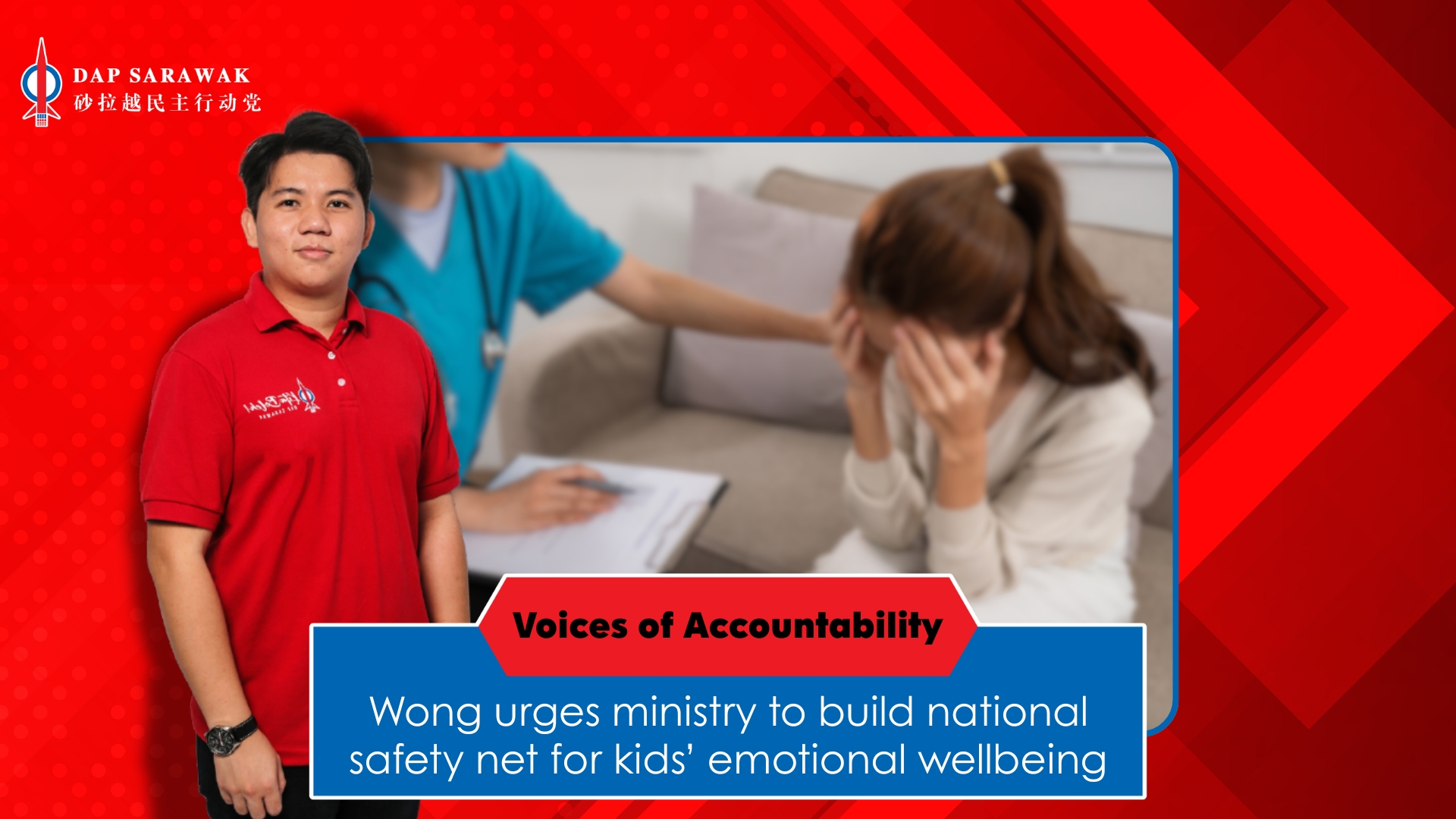
Kuching: DAPSY Sarawak Treasurer Wong King Yii has called on the Ministry of Women, Family and Community Development (KPWKM) to take the lead in establishing a national safety net for children’s emotional wellbeing, stressing that families need fundamental tools, not slogans, to address mental distress.
Wong said the Ministry must go beyond awareness campaigns and take tangible action to strengthen family and community-based mental health support.
“The Ministry must equip families with fundamental tools, not slogans, to recognise and respond to mental distress early.
“This means funding trained community counsellors in every district, setting up family support hotlines, and launching nationwide parenting workshops that teach emotional literacy, communication skills, and conflict resolution,” he said in a statement.
His remarks following the tragic stabbing incident at SMK Bandar Utama recently have shaken the nation to its core.
He added that parents are often the first to notice changes in their children but lack the training or resources to respond effectively.
Early intervention, Wong said, should begin at home – supported by a strong national framework that connects families, schools, and community services.
Beyond family-level support, Wong urged KPWKM to integrate mental health modules into existing welfare and childcare programmes.
“This would ensure that welfare officers, childcare providers, and community leaders are all equipped to identify early warning signs of distress among children.
“Public campaigns must go beyond
posters and hashtags. They should start real conversations, in schools, in neighbourhoods, and
in workplaces, about what it truly means to raise emotionally healthy children,” he said.
Wong said that Malaysia must confront the uncomfortable truth that mental health remains a “whispered topic” instead of a public conversation.
He highlighted that discussions in schools often focus on grades, discipline, and performance, while emotions, loneliness, and fear are neglected.
“This silence is dangerous. It makes those who struggle feel ashamed, afraid that opening up will only invite mockery, gossip, or judgment.
“No child should ever feel that seeking help is a weakness, and no school should ever allow emotional suffering to go unnoticed because it is ‘not part of the syllabus,” he said.
Wong emphasised the need to normalise conversations about mental health in schools, equating its importance with academic achievement.
“When a student breaks down, it should trigger compassion, not ridicule. Real progress begins when we stop treating emotional pain as a private flaw and start recognising it as a shared responsibility,” he added.
He called on parents to play an active role in identifying emotional distress among children, stressing the importance of training and support.
“A strong family is not built on silence or shame, but on connection, trust, and care,” he said.
Turning his attention to the Ministry of Education (MOE), Wong said that every school should be both a place of learning and protection.
While most schools have counsellors, he argued that many are “buried in bureaucracy” and unable to provide proactive support.
“Counsellors must be empowered to act, not just react. Teachers, too, need the time and space to truly see their students. The Ministry must reduce administrative burdens so educators can focus on their students’ wellbeing,” he said.
Wong further called on the Ministry of Health to work closely with the MOE to integrate mental health care into schools and communities through regular screenings, counselling, and coordination with local clinics.
Citing examples from other countries, Wong pointed to Singapore’s REACH programme, Japan’s MIRaES curriculum, and Australia’s YAM initiative as models Malaysia could learn from.
“The safety and sanity of our children cannot be left to chance. This tragedy must not fade into another headline.
“It must mark the beginning of systemic reform – where every ministry plays its part, every school takes responsibility, and every child knows: you are seen, you are heard, and you are safe,” he said.