Sibu: Malaysia’s education policy undergoes curriculum updates every eight to nine years to keep pace with global developments and progress, said Sibu MP Oscar Ling Chai Yew.
He said the Ministry of Education will implement a new curriculum in 2027 to ensure the national education system remains relevant and competitive.
“Among the issues currently being discussed is the proposal to allow six-year-old children to enter Year One of primary school.
“Many believe that six years old is too young; however, neighbouring countries such as Singapore have long allowed six-year-old pupils to enter Year One,” he said.
He stressed that the move is not a new innovation but aligns with international trends, particularly in response to population ageing, where countries need to develop productive human capital earlier by enabling students to graduate and enter the workforce sooner.
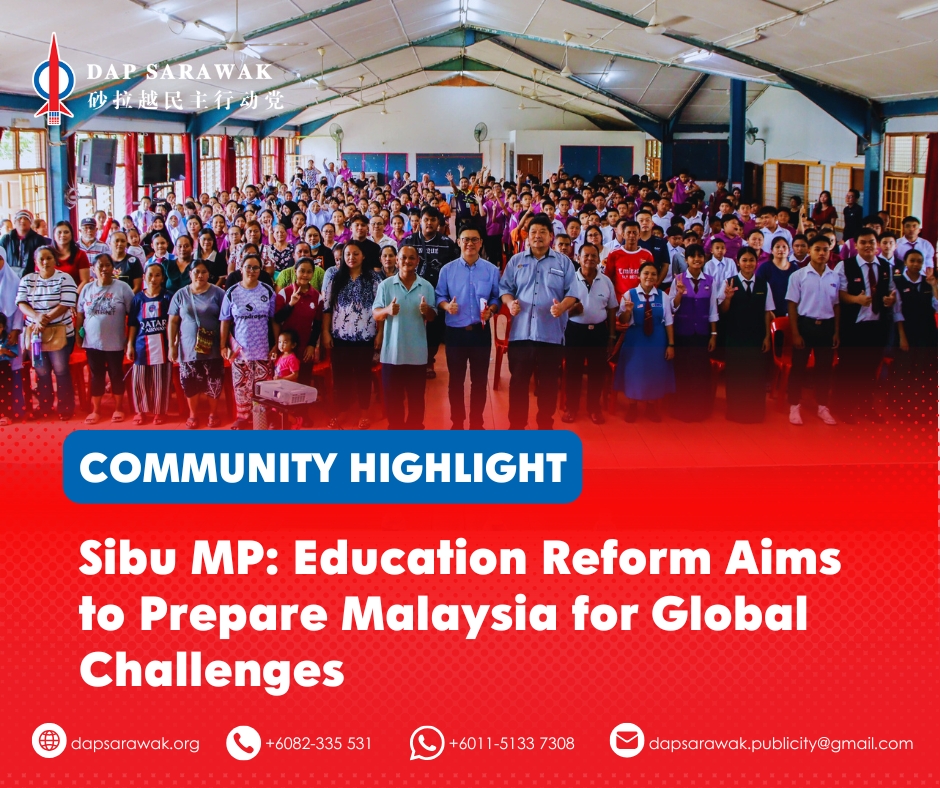
Ling made these remarks when delivering his speech as the guest of honour at the 2026 Early Schooling Assistance (BAP) Handover Ceremony held at SMK Bawang Assan here recently.
He said academic results have traditionally served as the primary benchmark for evaluating students, but education should focus on holistic development rather than examinations alone.
According to him, students possess different strengths, with some excelling academically while others are more inclined towards technical and vocational skills.
In line with this approach, Ling said the Ministry of Education has abolished the UPSR and PT3 examinations and has confirmed that both assessments will not be reinstated.
Ling also noted that SMK Bawang Assan is one of the larger schools in the Bawang Assan area, adding that Sibu’s education standards have consistently ranked among the top three nationwide.
He expressed hope that the school would continue to achieve further improvements and breakthroughs to maintain the district’s academic excellence.
On the BAP, Ling said the RM150 aid is provided on a non-discriminatory basis to all Malaysian students, whether they attend government or private schools.
“It is part of Malaysia’s education system, and as long as one is a Malaysian student, they are eligible to receive the RM150.
“This reflects that the government has begun implementing a non-discriminatory approach in the education sector,” he said.
He added that the government is also gradually implementing the recognition of the Unified Examination Certificate (UEC), including the formulation of standards to allow Chinese independent school students to enrol in local universities.
This, he said, demonstrates the MADANI Government’s inclusive and non-discriminatory approach towards all streams of education.