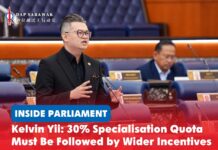

Kuala Lumpur: Bandar Kuching MP Dr. Kelvin Yii Lee Wuen has stressed that Sarawak’s oil and gas (O&G) rights are constitutionally protected and should not be overlooked, referencing both the Federal Constitution and the Malaysia Agreement 1963 (MA63).
Dr. Yii made the remarks during the debate on the Royal Address, responding to statements by the Minister in the Prime Minister’s Department (Law and Institutional Reforms) that Sarawak’s O&G rights are not explicitly mentioned in MA63.
He described such an interpretation as “too narrow” and failing to consider the historical and legal context of the states comprehensively.
“This issue is not just about resources; it is about the very foundation of our Federation. MA63 is not an ordinary document. It is a nation-building contract. It is the legal and political foundation on which Malaysia was formed as a federation of distinct entities, namely Malaya, Sabah, and Sarawak, each with its own history, laws, and sovereign nature.
“To claim that MA63 is irrelevant to natural resources simply because the words’ oil and gas’ do not appear verbatim is a fundamental misunderstanding of how the constitutional compact works,” Dr. Yii said.
He added that MA63 was never a statute about pipes or drilling licenses. It is Malaysia’s birth certificate. Nor can it be read exclusively in isolation.
“To understand its true meaning and intent, MA63 must be read in conjunction with the entire body of founding documents, especially the Intergovernmental Committee (IGC) Report on which it is based.
“It is this collective agreement that determines how sovereignty, legislative power and economic control will be divided. Its legal force is enshrined in the Federal Constitution itself,” he said.
He highlighted that the Constitution clearly establishes that land and natural resources belong to the states, with additional protections for Sabah and Sarawak under Article 95D.
Dr. Yii said the principle of state ownership is absolute and rooted in the definition of land; precisely, the Sarawak Land Code defines state land as including the sea within its extended boundaries.
“What was once called Crown Land before 1963 became, definitively, state land after Malaysia Day,” he pointed out.
“Why? Because when the Queen transferred sovereignty under MA63, it was transferred to the Sarawak government, not to the federation.
“Sovereignty over Sarawak, and with it the ownership and possession of the land and resources in Sarawak, was never vested in the federal government.
“This position was reinforced during our period of ‘self-governance,’ from 22 July 1963, until we helped form Malaysia on 16 September of the same year,” he said.
He added that oil and gas do not float in the air but are found underground and under the seabed.
“Here is a historical truth that we must not forget. If the federal government had the original, constitutional title to petroleum, then there would be no need for the Petroleum Development Act 1974 and the Territorial Sea Act 2012.
“Whether we agree or disagree with this Act or who passed it first is another discussion. However, this Act exists for one reason only; that is, because the ownership was not federal in the first place,” he said.
He further explained that Parliament enacted the law to gain control, not to confirm existing rights. When Sarawak exercised its rights under the Oil Mining Ordinance 1958, he said, it was not an act of protest.
“It was an act of legitimate continuation. It is the exercise of power and sovereignty that is the basis for the formation of a federation, and a right that should not have been surrendered in the first place.
“And I know that some aspects of this issue are now under consideration in the courts and I think that is the most appropriate arena to determine the validity of the interpretation of the constitution and our rights under MA63. I am confident in the rights that we have and await the decision of the court,” he said.
He also said that no rational government or territory would enter into a federation only to surrender its sovereignty and its major natural resources without a clear agreement.
“Acts of Parliament do not override constitutional structure. Political convenience does not defeat the conditions of establishment. Gradual centralization does not extinguish.
“The rights of Sabah and Sarawak are not a demand. They are a constitutional legacy, born of sovereign ownership that was never ceded. It is time that legacy is respected fully, according to the original offer,” he said.