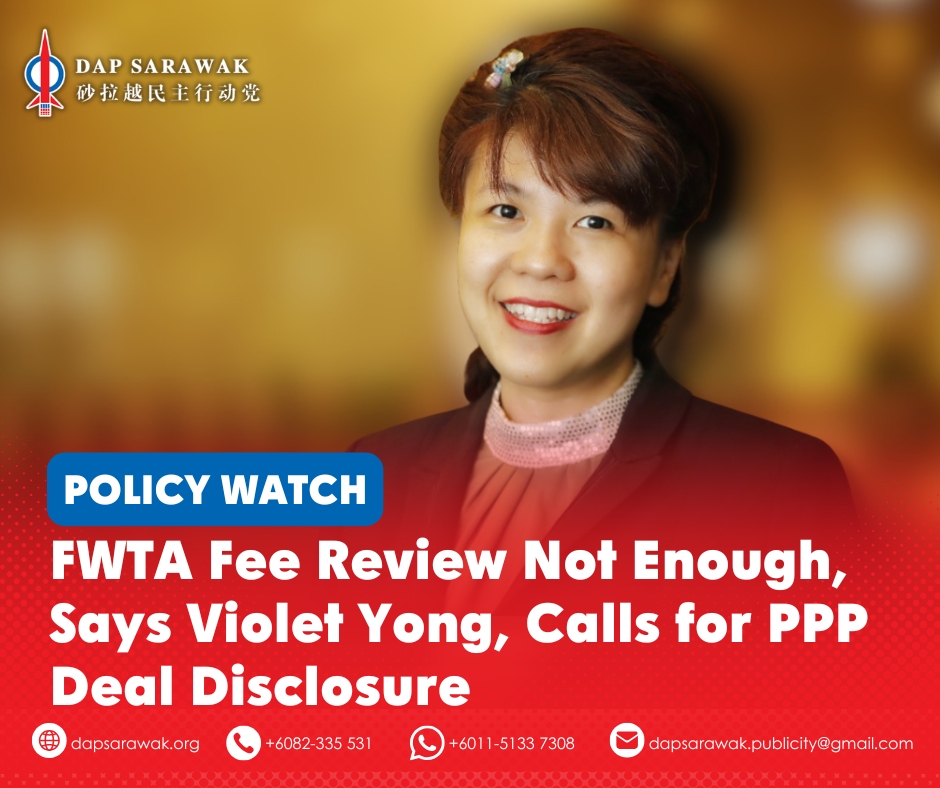
Kuching: ADUN for Pending Violet Yong has dismissed the Sarawak government’s latest announcement on reviewing Foreign Worker Transformation Approach (FWTA) fees as insufficient, arguing that employers need concrete action rather than repeated assurances.
Yong said the Premier had already announced in May that the state government would review FWTA charges to reduce the financial burden on employers but claimed no meaningful changes had been implemented two months later.
“Government should go beyond reviewing fees and instead address broader concerns surrounding the implementation of the foreign worker management system, particularly the Public-Private Partnership (PPP) agreement involving SOCOE Sdn Bhd,” she said in a statement.
According to Yong, the state government should disclose how the concession was awarded, the duration and terms of the agreement, the basis for determining FWTA charges, the revenue-sharing arrangement between the government and the concessionaire, and the identities of the company’s ultimate beneficial owners.
She argued that Sarawakians were entitled to know who ultimately benefits from the arrangement, especially as employers are required to pay mandatory FWTA charges to hire foreign workers.
Yong also questioned why a private company had been allowed to collect what she described as potentially hundreds of millions of ringgit annually through compulsory fees without the government revealing the total amount collected or how the proceeds are distributed.
She further raised concerns about the decision by the Immigration and Labour Management Unit (ILMU), under the Premier’s Department, to award the development and implementation of the system to a private company rather than the state-owned technology firm SAINS.
“If the objective of FWTA, together with the Sansols and HAVEN platforms, was to integrate the systems of ILMU, the Labour Department (JTK) and the Immigration Department (JIM), the government should explain why SAINS was not entrusted with developing and managing the project, and why a 15-year concession was instead granted to a private entity,” she said.
She also questioned whether sufficient feasibility studies, technical evaluations, and due diligence had been conducted before the concession was awarded, citing complaints from employers over repeated system failures, processing delays, cumbersome procedures, and a platform that she said remains difficult to use despite the mandatory fees imposed.
Yong argued that, rather than improving efficiency, the implementation of FWTA, Sansols, and HAVEN had increased employers’ compliance costs and administrative burdens.
“A digital transformation project should simplify processes and improve efficiency, not make compliance more expensive and more complicated.
“If the Sarawak Government is truly committed to easing the burden on employers, reviewing the fee alone is not enough. It must also come clean on the PPP agreement, disclose the financial arrangements, explain the basis for awarding the concession, and be fully accountable to the people of Sarawak,” she said.