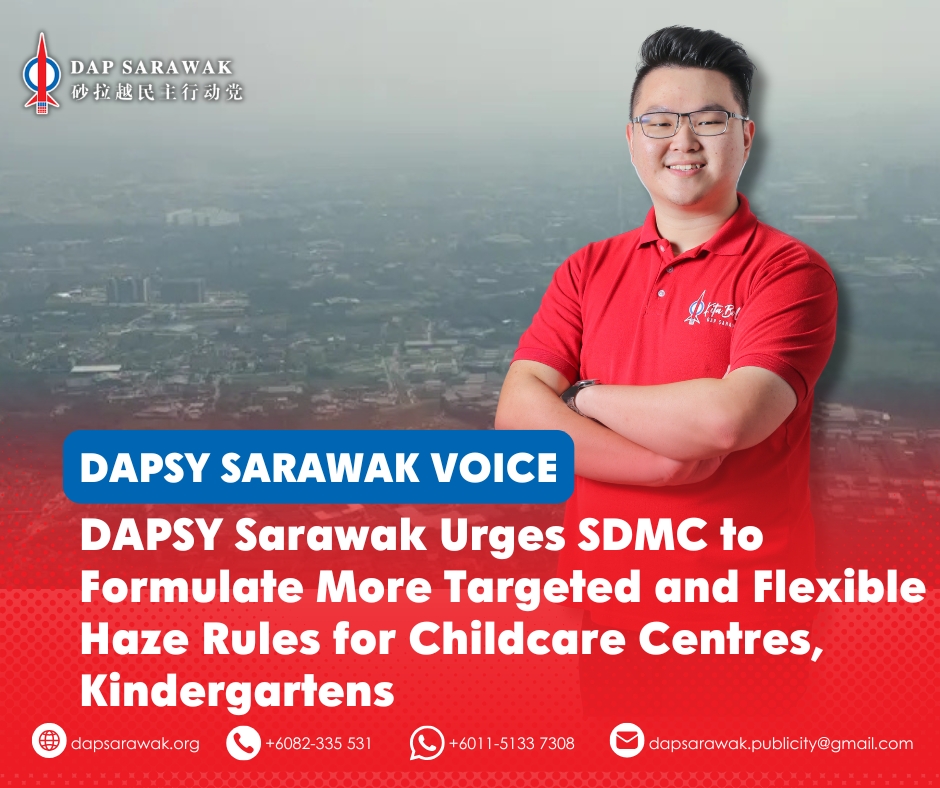
Kuching: DAPSY Sarawak Secretary George Lam has urged the Sarawak Disaster Management Committee (SDMC) to formulate more targeted regulations for childcare centres and kindergartens during periods of severe haze, based on their indoor facilities and air management capabilities.
Lam said childcare centres and kindergartens with good indoor environments and adequate protective measures should be allowed to remain operational even when the Air Pollutant Index (API) exceeds 200.
“Provided that they comply with the necessary health and safety standards and completely prohibit outdoor activities, this would allow us to protect children’s health while avoiding unnecessary disruption to the work arrangements of dual-income families,” he said.
He said regulations should take into account the different conditions and facilities available at individual childcare centres and kindergartens, rather than imposing a blanket closure policy.
Lam said a more flexible approach would help protect children’s health while avoiding unnecessary disruption to the work arrangements of dual-income families.
“Reviewing this policy does not mean lowering the standards for protecting children’s health. Rather, I hope the authorities can strike a better balance between children’s safety, early childhood education and the practical needs of families,” he said.
He added that while the health and safety of children must remain the priority, a blanket closure policy could place significant pressure on working parents, particularly dual-income families who would need to make alternative childcare arrangements.
He said many childcare centres and kindergartens already have indoor activity spaces and can implement measures to minimise children’s exposure to polluted air, including completely prohibiting outdoor activities and closely monitoring their health.
“During periods of severe air pollution, sending children to childcare centres or kindergartens with proper indoor environments may not necessarily result in significantly greater exposure to indoor air pollution compared with keeping them at home,” he said.
He proposed that different standards be established based on factors such as the availability of suitable indoor facilities, air management systems and the ability to completely suspend outdoor activities.
He noted that the impact of school closures was different for primary and secondary school students, who could continue learning through online classes or teaching videos when schools were closed due to hazardous air quality.
“However, the situation is different for childcare centres and kindergartens. Young children are unable to remain focused on online classes for extended periods, while teachers cannot rely solely on screens to provide the necessary care, interaction and learning,” he said.