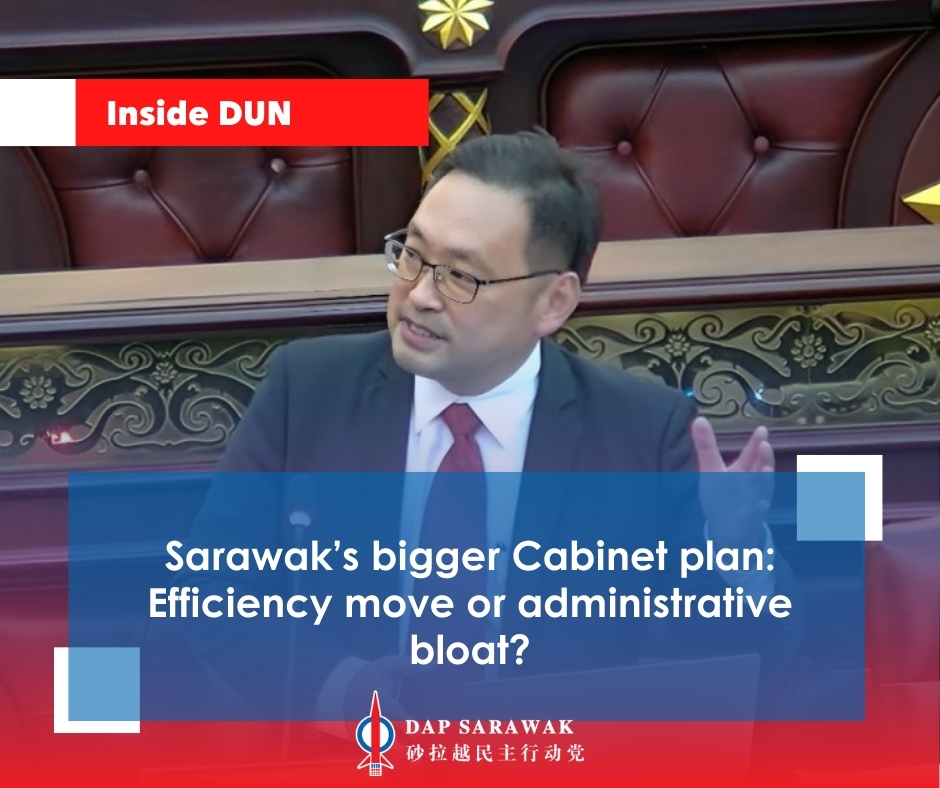
Kuching: Sarawak’s plan to enlarge its state Cabinet has drawn renewed scrutiny in the Dewan Undangan Negeri (DUN), with Padungan assemblyman Chong Chieng Jen questioning how a bigger ministerial line-up fits into the state’s own pledge to build a “leaner and more agile” government.
The Constitution of the State of Sarawak (Amendment) Bill 2025, which proposes raising the number of ministries from 10 to 14, was moved through DUN yesterday.
But Chong said the proposal stood in contrast to the Premier’s recent call for streamlined operations across government departments and state-owned enterprises (SOEs).
He noted that in his budget speech earlier, Premier Datuk Patinggi Tan Sri Abang Johari Tun Openg emphasised cutting overlaps, reducing bureaucracy, and improving organisational efficiency.
Chong told the House that these goals would be challenging to reconcile with a growing Cabinet.
“On one side, we are urging civil servants and Sarawak-owned enterprises to do more with fewer people. On the other hand, we are creating more ministerial positions,” he said. “It sends mixed signals on what we mean by efficiency.”
More seats at the front bench?
Chong, who is also DAP Sarawak Chairman and Stampin MP, highlighted that almost half the 82 assemblypersons already hold positions in the administration – from the Premier and 10 ministers to 27 deputy ministers.
He said the proposed expansion could push the government closer to having nearly half the legislative chamber seated on the front bench.
He described this as a scenario that could resemble an “over-bloated administration,” adding that the state must guard against the perception of unnecessary growth at the top.
Are ministers overburdened? No indication, Chong says
The government has argued that a larger Cabinet would help distribute responsibilities more evenly. But Chong questioned whether there is actual evidence of overloaded ministries, pointing out that no minister has publicly said they are struggling to cope with their portfolio.
“If workload is the concern, it should be supported by clear justification,” he said.
Costs that add up
Chong also raised financial considerations tied to adding ministerial positions, including salaries, allowances, official staff, support personnel, and office operations. Each new ministry, he noted, carries recurring expenses that grow over time.
“With fluctuating revenue and budget deficits projected in the coming years, prudence is essential,” he said. “Decisions at the top must be weighed not just for today, but for the long-term commitments they create.”
Civil service capacity – a better investment, Chong argues
Chong suggested that strengthening the civil service, exceptionally specialised roles such as scientists, engineers, and technical experts, would deliver better value and directly support Sarawak’s shift toward green energy and hydrogen industries.
“These are the people driving the state’s new economic direction,” he said. “Building their capacity would have a far greater impact than adding more ministers.”
Efficiency is not measured by Cabinet size
Chong concluded that the effectiveness of the administration does not hinge on the number of ministers it has but on how well each minister carries out their responsibilities.
“Good governance comes from oversight, focus, and follow-through, not from expanding ministerial seats,” he said.