
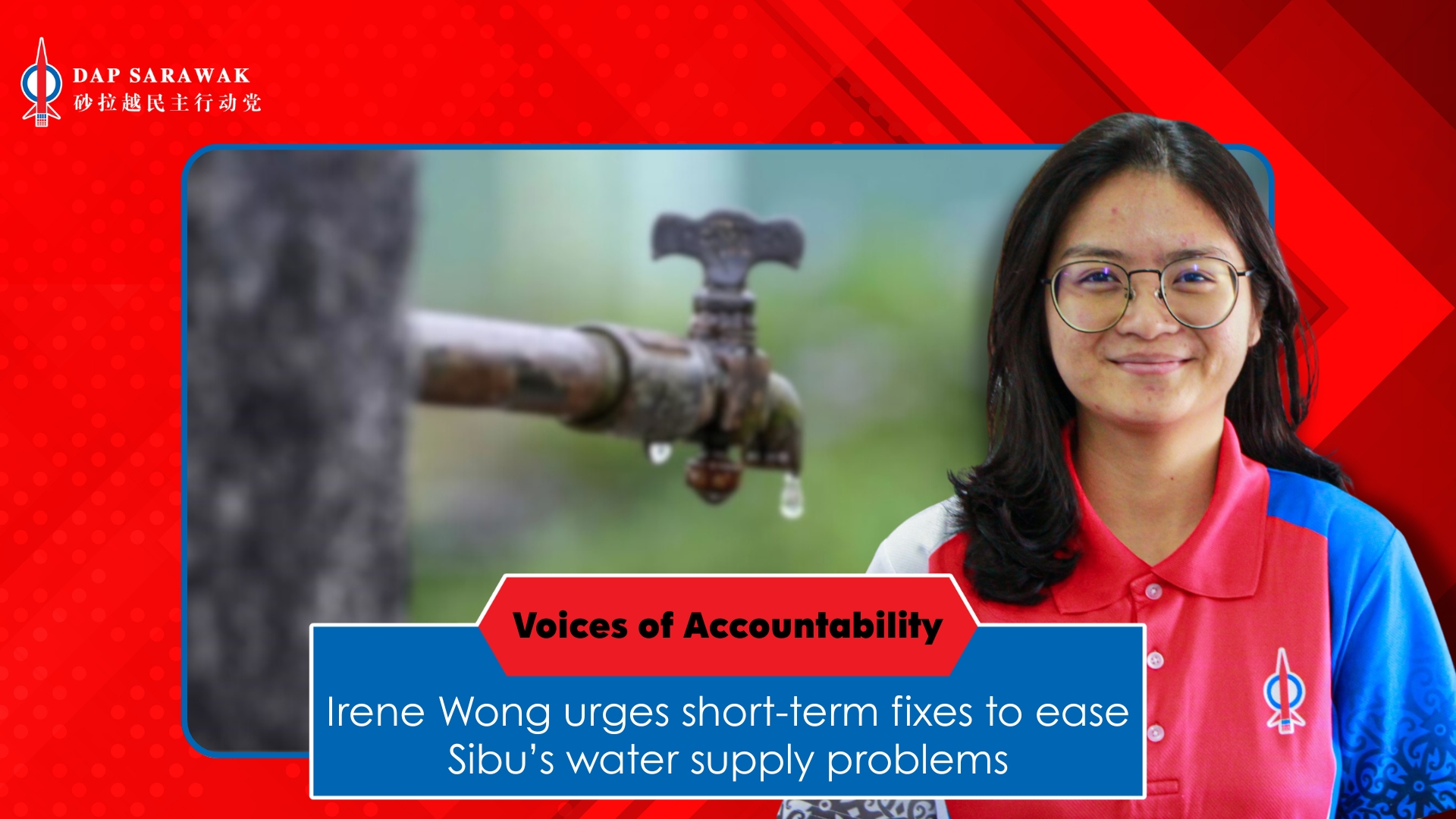
Sibu: Special Assistant to Sibu MP Oscar Ling, Irene Wong, has urged the government to implement short-term measures to tackle persistent water supply issues affecting residents and businesses in several parts of Sibu.
She proposed setting up small-scale, temporary water filtration facilities—similar to those operating in the Sibu West Bank and Kwong Hua areas—or installing booster stations in low-pressure zones, such as Rantau Panjang and Tanjung Kunyit.
“These measures would help ease the long-standing problems of water disruption and low pressure in the shortest possible time,” Wong said in a statement.
According to her, Ling’s service team recently received numerous complaints from residents of Rantau Panjang and local shipyard operators, prompting an on-site inspection.
Residents reportedly continue to experience water shortages even when no rationing is in place, with many saying that “turning on the tap but no water flows” has become a daily occurrence.
The situation worsened recently following a burst underground main pipeline near the Sibu Foochow Association hall, which remains under repair. The low pressure, residents said, makes it difficult for them to store water for emergencies.
Meanwhile, shipyard operators informed Ling’s team that, due to several days without a water supply, workers were forced to bathe by the riverside—an unsafe practice given the occasional sightings of crocodiles in the area.
Wong highlighted that the rapid expansion of residential and commercial zones in Sibu has driven up water demand each year; yet, outlying industrial areas such as Rantau Panjang and Tanjung Kunyit continue to face chronic low water pressure.
“This issue has persisted for at least five years without an effective solution,” residents reportedly said.
Wong emphasised that while the state government continues to promote urban development, it must also ensure comprehensive planning that includes rural and industrial zones.
“Local development rests in the hands of the state government, which should not focus solely on city-centre growth while neglecting the basic needs of outer areas,” she said.
She noted that the expansion of the Salim Water Treatment Plant, expected to be completed only by 2027, is a long-term project, and that immediate interim measures are necessary.
“The authorities should consider temporary filtration plants or booster stations in low-pressure areas to ensure residents can at least meet their basic water needs,” she added.
Wong further pointed out that despite Sarawak’s record RM14.2 billion state budget this year, insufficient attention has been given to improving local water infrastructure.
“It is regrettable that despite such a massive budget, the people’s basic needs are still being overlooked.
“Water supply is fundamental, yet rural residents continue to live with the reality of ‘big budget but no water,'” she said, calling the situation an imbalance in resource allocation and misplaced policy priorities.
She urged the government to heed public concerns and take immediate, concrete action—starting with short-term solutions while expediting the expansion or construction of new treatment facilities.
“Only by doing so can both urban and rural residents enjoy a stable and sufficient water supply,” she said.