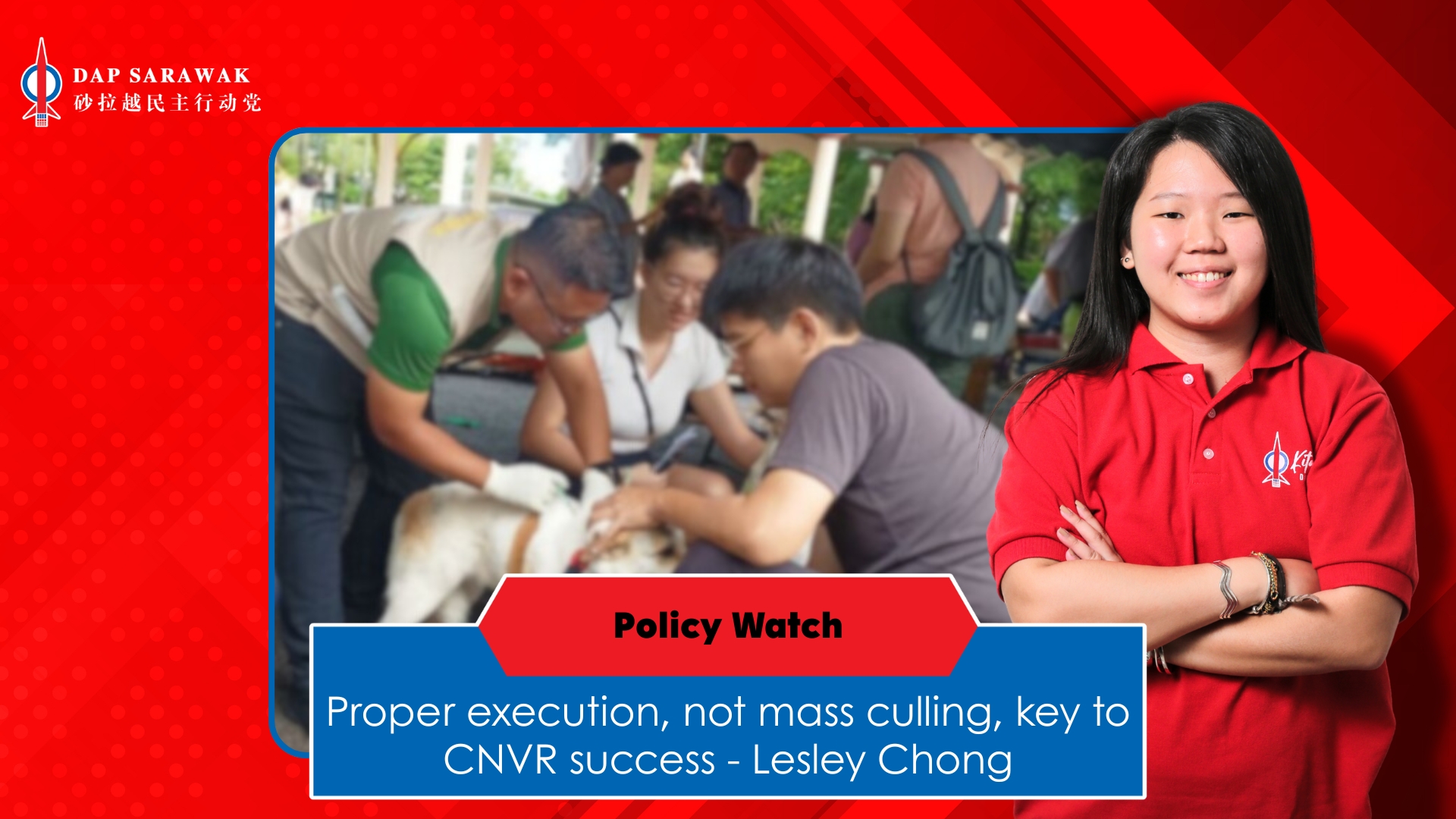
Kuching: DAPSY Kuching Secretary Lesley Chong has cautioned that the success of the Catch-Neuter-Vaccinate-Return (CNVR) programme announced by the Kuching South City Council (MBKS) depends on proper planning, transparency, and collaboration with animal welfare experts.
Chong welcomed the initiative as a humane and science-based approach to managing the stray population and reducing rabies cases, but warned that poor execution could render it ineffective.
“Without proper planning and collaboration, this initiative risks falling short.
“Indiscriminate mass culling, which has been carried out by the council all this while, is inhumane, ineffective, and has failed to reduce rabies cases over the past few years,” she said in a statement.
She urged MBKS to work closely with NGOs and animal welfare experts who have hands-on experience in CNVR implementation, emphasising that technical guidance and coordination are essential for success.
Before the programme begins, Chong said several key operational questions must be addressed:
1. Post-treatment care: Where will sterilised and vaccinated dogs be kept? Will they be released back into their territories or temporarily housed for monitoring? She also questioned whether the Sarawak Society for the Prevention of Cruelty to Animals (SSPCA) has resolved the flooding issue at its current shelter and sought clarification on the land granted by the State Government in 2017 for its relocation.
2. Monitoring and follow-up: What system will track each dog’s health, vaccination, and sterilisation status, and how will follow-up vaccinations and welfare monitoring be conducted?
3. Policy consistency: Will MBKS fully commit to CNVR and cease the practice of indiscriminate mass culling, which has been shown to weaken herd immunity and worsen the rabies situation?
Chong also highlighted animal abandonment as one of the root causes of stray overpopulation and the persistence of rabies in Sarawak.
“Many of these abandoned dogs are unvaccinated and unsterilised, undermining herd immunity and allowing rabies to continue spreading,” she said.
She further called for complete transparency and accountability in the implementation of the CNVR programme. She urged SSPCA to clarify the status of the promised Animal Village land so it can be utilised as part of the effort.
Chong also appealed to the Sarawak State Government to consider extending the Animal Welfare Act 2015 (AWA 2015) to Sarawak, thereby strengthening animal welfare laws and enforcement mechanisms.
“Each of these steps is crucial,” she said. “If even one is missing, we will not be able to achieve sustainable animal welfare nor effectively reduce rabies cases in Sarawak.”