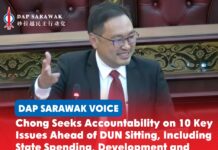
Kuching: In the wake of a recent settlement between the federal government and Sarawak over oil and gas rights, Padungan assemblyman Chong Chieng Jen has raised concerns over the lack of transparency and mixed political messaging.
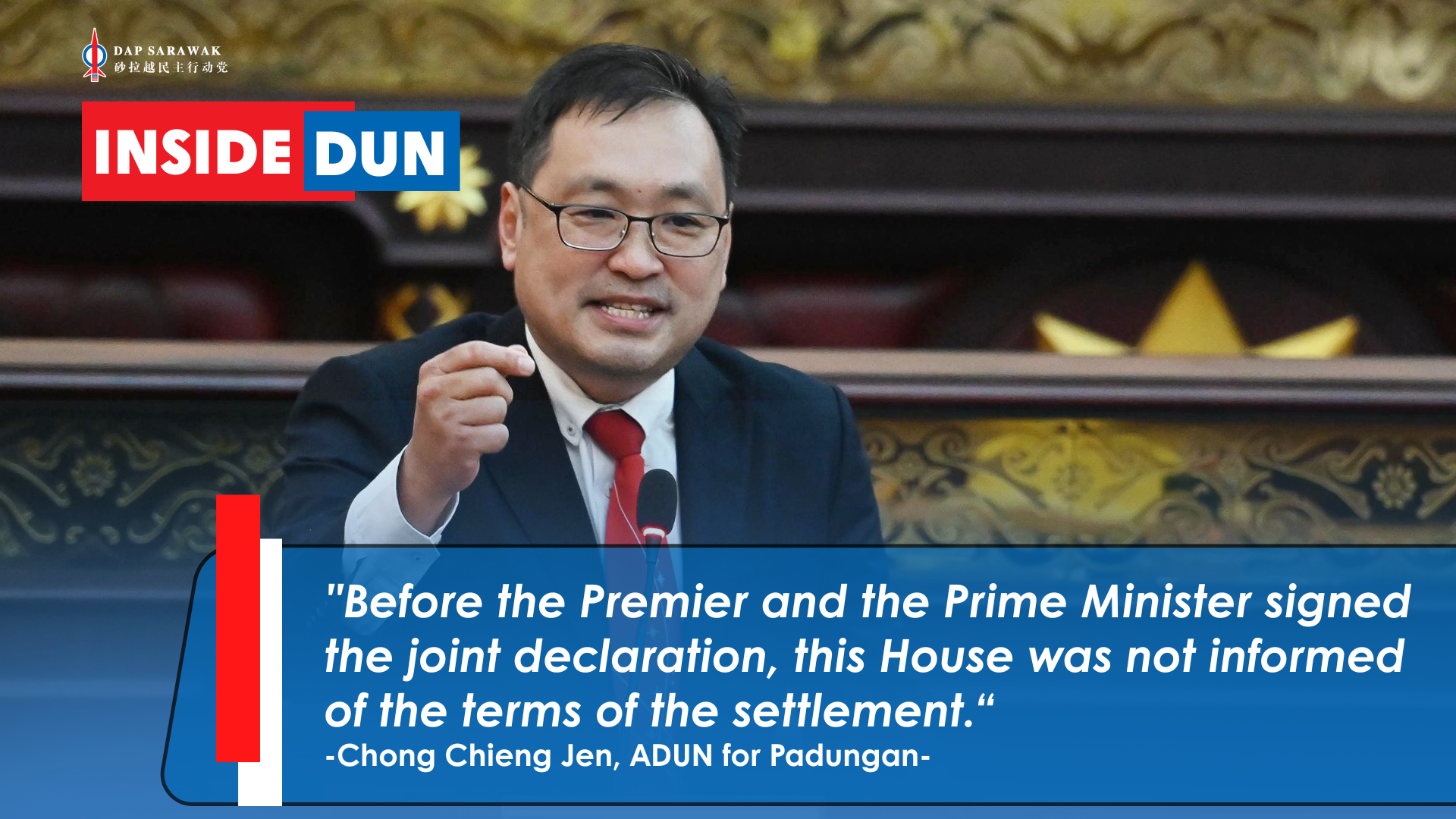
“Before the Premier and the Prime Minister signed the joint declaration, this House was not informed of the terms of the settlement.
“We only learned about the details through media reports – either in the newspapers or on social media. The terms appear to be quite similar to what YB Azalina had previously stated in Parliament and to the ministerial statement made by the Prime Minister in March this year,” Chong said during his debate at Sarawak State Legislative Assembly (DUN) sitting today.
On 21 May 2025, Prime Minister Datuk Seri Anwar Ibrahim and Premier Sarawak Datuk Patinggi Tan Sri Abang Johari Tun Openg signed a joint declaration signifying the agreement to settle the dispute over oil and gas matter between Petronas and Petros.
Under the agreement:
1. The Sarawak State Government acknowledges the validity of the Petroleum Development Act 1974 (PDA 1974).
2. Existing Petronas contracts – whether production-sharing contracts for oil or gas supply agreements – remain intact. Essentially, it is business as usual for Petronas.
3. Petros is recognised as the aggregator for gas distribution within Sarawak. However, its role in the export of gas, particularly LNG, remains unclear.
4. Petronas also made a promise to involve Petros in future ventures, but the promise to “use best endeavours” is vague and lacks legal weight. As lawyers, we know such language amounts to little.
Legal contradictions and political silence
Added to his debate, Chong questioned the internal consistency of the Sarawak government’s position.
“While the Honourable Premier has signed an agreement recognising the validity of PDA 1974, some members of this House continue to assert that the Act is unconstitutional.
“For example, the Member for Kota Sentosa has not only questioned the Act but outright declared it unconstitutional – this is on record in the Hansard and was reported in the newspapers today.
“So, is Kota Sentosa accusing the Premier of doing something unconstitutional? That is a serious allegation. If SUPP maintains that PDA 1974 is unconstitutional, are they going to take the Premier to task for recognising it?” he asked, noting that the Sarawak United People’s Party (SUPP) has been very vocal against the PDA 1974 and gone largely silent since the declaration was signed.
Acknowledging the effort by the Premier in negotiating for more oil and gas rights for Sarawak, Chong said the Premier has tried but believes he could have done better.
“He entered negotiations with his hands tied by the decisions of previous Chief Ministers,” he said.
Historical context and legal standing
Chong further traced the roots of the controversy back to 1974 when Tun Taib Mahmud, then the Federal Minister for Natural Resources, tabled the Petroleum Development Bill in Parliament. The then Chief Minister of Sarawak, Tun Abdul Rahman Ya’kub, who was also an MP, gave full support. The Act passed with their endorsement.
“Some claim the PDA was never approved in this House. However, our annual Budgets consistently acknowledge receipts derived from PDA 1974. In those Budget documents, these revenues are referred to not as royalties but as “compensation in lieu of rights” – oil and gas rights. That clearly implies Sarawak gave up those rights in exchange for compensation.
“Therefore, legally speaking, I believe PDA 1974 is a valid law. It has been endorsed both by this House and by the Premier. It would be a stretch to now claim that it is unconstitutional,” he said.
Chong reiterated his stance that the PDA 1974 is valid.
“But I understand that legality and political strategy are separate matters. Ultimately, the courts will be the final arbiter. For those still confused about our position, I suggest reading our views in the latest issue of Rocket Publication – we’re selling it at RM3.
“Legally, it would be difficult to invalidate the PDA. But politically, Sarawak holds an advantage: 1. West Malaysia’s political landscape is fragmented. 2. We have a Prime Minister who is open to accommodating Sarawak’s demands,” he said.
Chong added his concern that the current agreement is not new – similar understandings were reached in the past.
“Yet, every time, people go to court or make contradictory political statements, like Kota Sentosa calling the Act unconstitutional. This continuous challenge will hurt us – Sarawak, Malaysia, and our economy.
“For instance, ConocoPhillips has withdrawn a US$3.1 billion investment due to legal uncertainty. This is the kind of loss we must avoid.
“Let us be clear, consistent, and united. Sarawak deserves better, but we must also be strategic and responsible in how we pursue our rights,” he said.