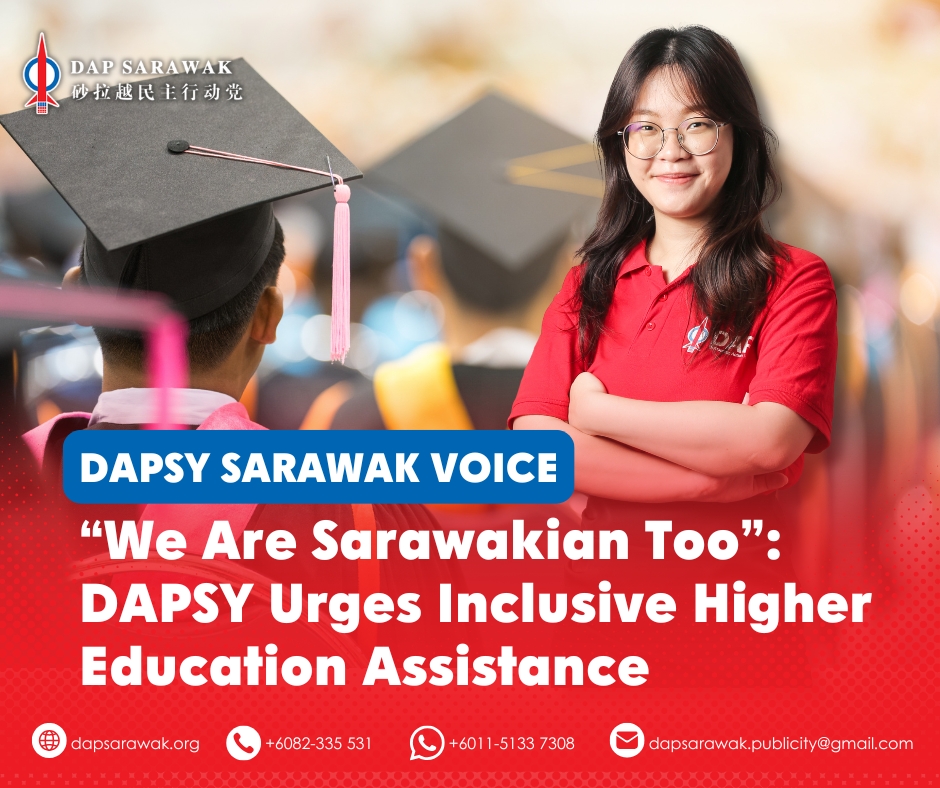
Kuching: DAPSY Sarawak has urged the Sarawak Government to review and broaden the eligibility criteria for Bantuan Kemasukan ke Institusi Pengajian Tinggi (IPT) to ensure Sarawakian students are not excluded based on their chosen institution or education pathway.
Its Varsity Affairs Director Arlena Wee Shi Ying said that while DAPSY supported efforts to reduce the financial burden on Sarawakians pursuing higher education, gaps remained in existing assistance programmes, particularly for students enrolled in private higher education institutions.
She said there was a misconception that students attending private universities came from financially well-off families, when many families actually made significant sacrifices while students relied on PTPTN and other education loans.
Arlena cited data reported by The Edge Malaysia, which indicated that students in private institutions accounted for approximately 180,000 new PTPTN recipients annually, demonstrating the significant number of students relying on financial assistance to pursue higher education.
She also highlighted the disparity between students benefiting from Sarawak’s free tertiary education initiatives and those pursuing studies through other recognised pathways.
“Sarawakian students who benefit from the free tertiary education scheme may receive substantial assistance towards tuition, accommodation and living expenses of up to RM15,000 annually.
“While another Sarawakian student pursuing a recognised programme through a different institution may remain ineligible for even a one-off entry assistance of RM1,000 for studies within Sarawak or RM1,500 for studies outside Sarawak,” she said.
Arlena stressed that even RM1,000 or RM1,500 could significantly help students cover accommodation, food, transportation, books and other essential expenses during their first year of university.
“The question is never whether the RM10,000 stipend should be taken away from those who receive it. The question is whether the Government’s resources and policies are reaching all Sarawakian students who genuinely need support.
“If the principle is truly “Sarawak for all Sarawakians,” then we must ask: is this genuinely Sarawak for all Sarawakians, or is it simply a political convenience that benefits those who happen to fit within the scheme?” she asked.
DAPSY Sarawak called for the eligibility criteria to be expanded so that academically qualified Sarawakian students with valid Sarawakian status can receive assistance regardless of their chosen institution or educational pathway.