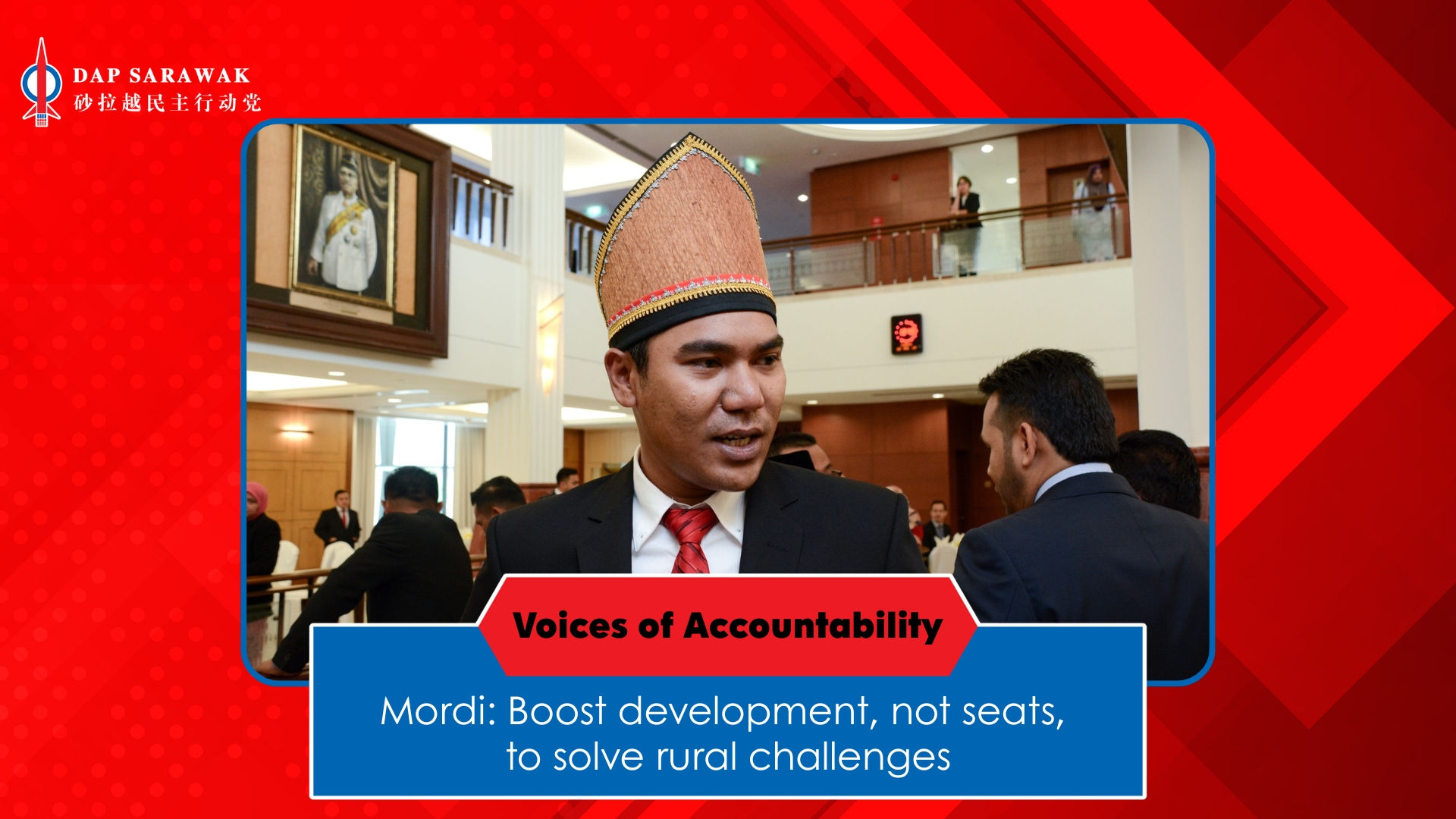
Bau: The Democratic Action Party (DAP) Sarawak Vice Chairman Mordi Bimol has raised concerns over the recent passing of the Sarawak State Legislative Assembly (Composition of Membership) Bill 2025, which adds 17 new state seats, bringing the total to 99.
In a statement issued yesterday, Mordi, who is also Mas Gading MP, said that the argument that rural assemblymen are overburdened by the vastness of their constituencies is not a valid reason to expand the state seats.
He pointed out that Sarawak state government assemblymen already receive substantial development allocations – at least RM9 million annually, while opposition-held constituencies often receive no funding at all.
“If the real issue is development constraints, the solution should be increasing project allocations, not the number of DUN seats, especially in rural areas,” he stated.
He further highlighted that 10 rural constituencies, including Opar, Tanjong Datu, Tasik Biru, Serembu, Tarat, Kedup, Bukit Semuja, Tebedu, Mambong, and Balai Ringin, are already beneficiaries of special grants from the Greater Kuching Coordinated Development Agency (GKCDA), with allocations reportedly reaching up to RM150 million per constituency.
In addition, Mordi stressed the importance of ensuring ethnic diversity and population balance in the redelineation process.
“There must be no overrepresentation of one group at the expense of others. The redelineation process must be guided by the principle of ‘one person, one vote, one value,’” he asserted.
Mordi’s remarks come in response to the passing of the Sarawak State Legislative Assembly (Composition of Membership) Bill 2025 on 7 July 2025, which increased the number of seats in the DUN from 82 to 99.
He asserted that the priority should not be on increasing the number of seats but instead on conducting a comprehensive and fair redelineation of electoral boundaries to improve administrative efficiency and ensure balanced representation.
“Many parliamentary and state constituencies today cut across district and local government boundaries, making coordination and service delivery inefficient,” he said, citing the Santubong parliamentary constituency as an example, which spans both Kuching and Lundu districts and falls under different local councils.
He also urged the Federal Government to prioritise increasing parliamentary seats for Sarawak by 14 to 17 seats to restore the original one-third representation for Sabah and Sarawak in the Dewan Rakyat as promised under the Malaysia Agreement 1963 (MA63).
Finally, he called on the Sarawak Government and the Election Commission (EC) to ensure that any redelineation process is conducted transparently, based on public data, and with inclusive consultation involving citizens, NGOs, opposition parties, and independent experts.
“Unilateral seat increases without public consultation will only undermine trust in democratic institutions,” he cautioned.