
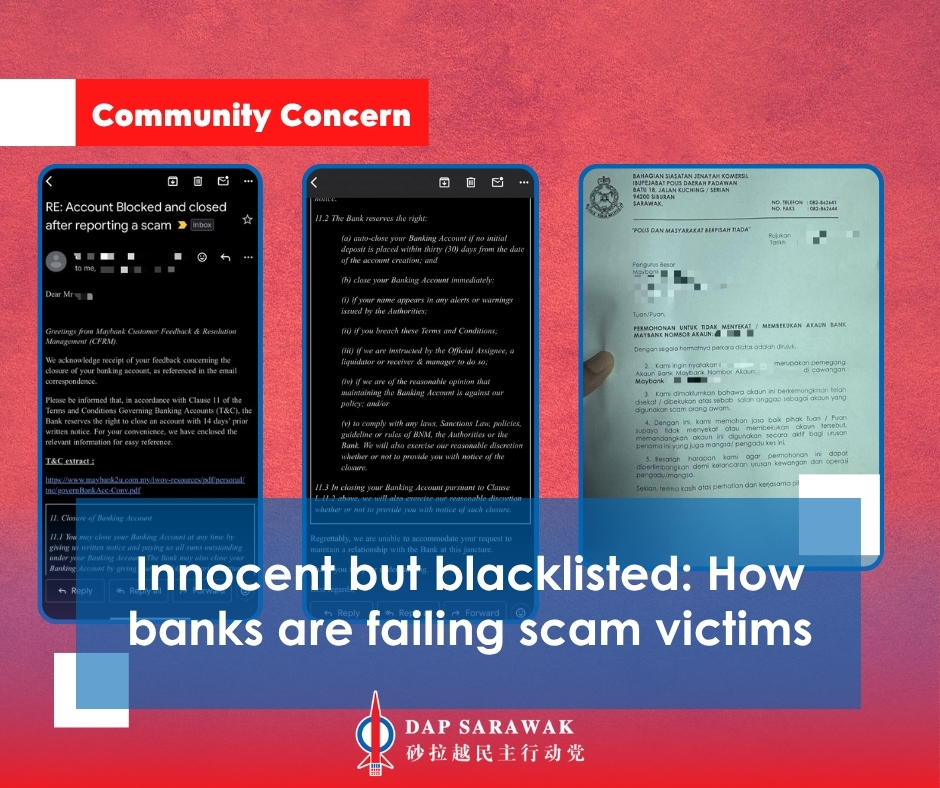
Kuching: A watch collector who fell victim to an online scam has found himself unfairly penalised by local banks, after his account was closed and he was subsequently blacklisted across financial institutions despite being the victim of fraud.
According to Michael Kong Feng Nian, Special Assistant to Stampin MP Chong Chieng Jen, the victim, identified only as Mr. Sim, had responded to a Facebook advertisement offering a watch for sale.
“He paid RM630 to the seller, but later discovered that the seller had disappeared and could no longer be contacted.
“Mr. Sim acted responsibly by lodging a police report immediately after realising he had been scammed,” Michael Kong said in a statement.
However, instead of being treated as a victim, Mr. Sim’s Maybank account was unilaterally flagged and subsequently closed.
“The bank cited Clause 11 of its Terms and Conditions Governing Banking Accounts, which allows it to close accounts with 14 days’ notice.
“Despite being informed that Mr. Sim was a scam victim and that his account was never used as a mule account, Maybank refused to reconsider its decision,” Michael Kong explained.
As a result, Mr. Sim has since been blacklisted by multiple banks. Even his company’s application for a card payment terminal was rejected by Ambank due to the blacklist status.
“This is deeply unjust. Mr. Sim has lost money to a scammer and is now suffering long-term financial exclusion through no fault of his own,” Michael Kong said.
He added that this case underscores a troubling trend where scam victims are effectively punished twice – first by fraudsters, and then by the financial institutions meant to protect them.
Michael Kong said he would assist Mr. Sim in raising the matter with Bank Negara Malaysia and urged banks to adopt a more balanced and fair approach when assessing accounts linked to scam investigations.
“Financial institutions must distinguish clearly between scammers, mule account holders, and victims of scams. Otherwise, public trust in the banking system will continue to erode,” he warned.