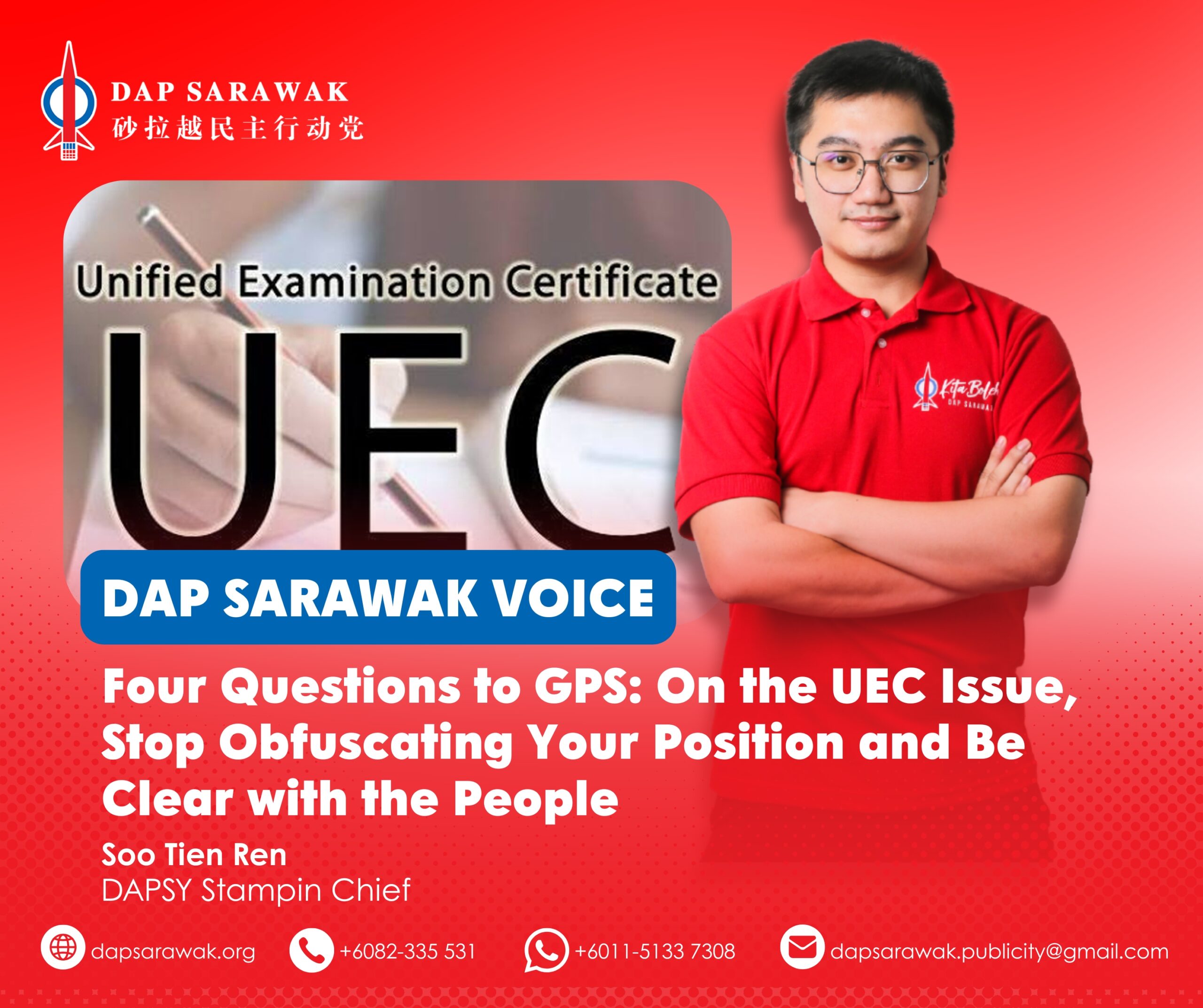
Kuching: Following the recent written parliamentary reply by the Minister of National Unity, Aaron Ago Dagang, to a question on the recognition of the Unified Examination Certificate (UEC), in which he reiterated that the government’s position “remains unchanged” and claimed that recognising the UEC could affect national unity and social harmony, the DAPSY Stampin expresses deep regret and must formally raise serious questions to the minister and his party.
The UEC is not a new issue. For decades, it has been a structural problem affecting the educational pathways of hundreds of thousands of students.
More importantly, it is a test of whether the unity government is genuinely committed to the principles of diversity, inclusiveness, and fairness.
Negative statements from members of the Cabinet only deepen public doubt and stand in clear contradiction to the reform efforts currently being pursued within the government itself.
In this regard, on behalf of the DAPSY Stampin, I pose four questions to GPS:
First Question:
In his written reply to Parliament, the Minister of National Unity claimed that recognising the UEC could “spark domestic tension.”
Does this represent the official position of GPS? If so, does this mean that GPS agrees with the assertion that the UEC undermines national unity?
Second Question:
As a component party of the unity government, DAP has, over the past period, actively pursued substantive progress within the system.
This includes securing the requirements of a credit in Bahasa Malaysia and a pass in Sejarah, allowing UEC holders to apply for admission to public universities.
Given that the UEC has already been incorporated into the public higher education system in practice, does this not amount to a de facto recognition?
Is the minister’s claim of “non-recognition” deliberately ignoring policy advances that already exist within the government?
Third Question:
If the collective Cabinet position continues to be defined as “not recognising the UEC,” is GPS prepared to work alongside DAP at the Cabinet level to continue advancing this reform?
Or does GPS merely pay lip service to diversity and inclusiveness while retreating or avoiding responsibility when it comes to actual decision-making?
Fourth Question:
Sarawak has, on multiple occasions, publicly expressed support for the recognition of the UEC.
Yet at the parliamentary and federal levels, GPS ministers are allowed to deny recognition of the UEC on the grounds that it “spark domestic tension.”
Does this not amount to a double standard – one position in Sarawak and another at the federal level?
Is such an approach not creating policy disparities between Peninsular Malaysia and Sarawak, undermining inter-ethnic trust, and widening differences between regions, contrary to the stated objective of promoting unity?
DAP has always maintained that true national unity is not achieved by denying the educational efforts of any community but through institutional reform that ensures all Malaysians have fair and equal opportunities for upward mobility within a shared national framework.
The UEC is not the source of division. Inconsistency and duplicity in political positions are what truly erode unity.
We therefore call upon GPS – especially its ministers who sit in the Cabinet – to give the people a clear and honest answer:
Do you want a genuinely inclusive, diverse, and forward-looking Malaysia, or will you continue to say different things in different settings?
Soo Tien Ren
DAPSY Stampin Chief
Special Assistant to Stampin MP Chong Chieng Jen
13 February 2026