
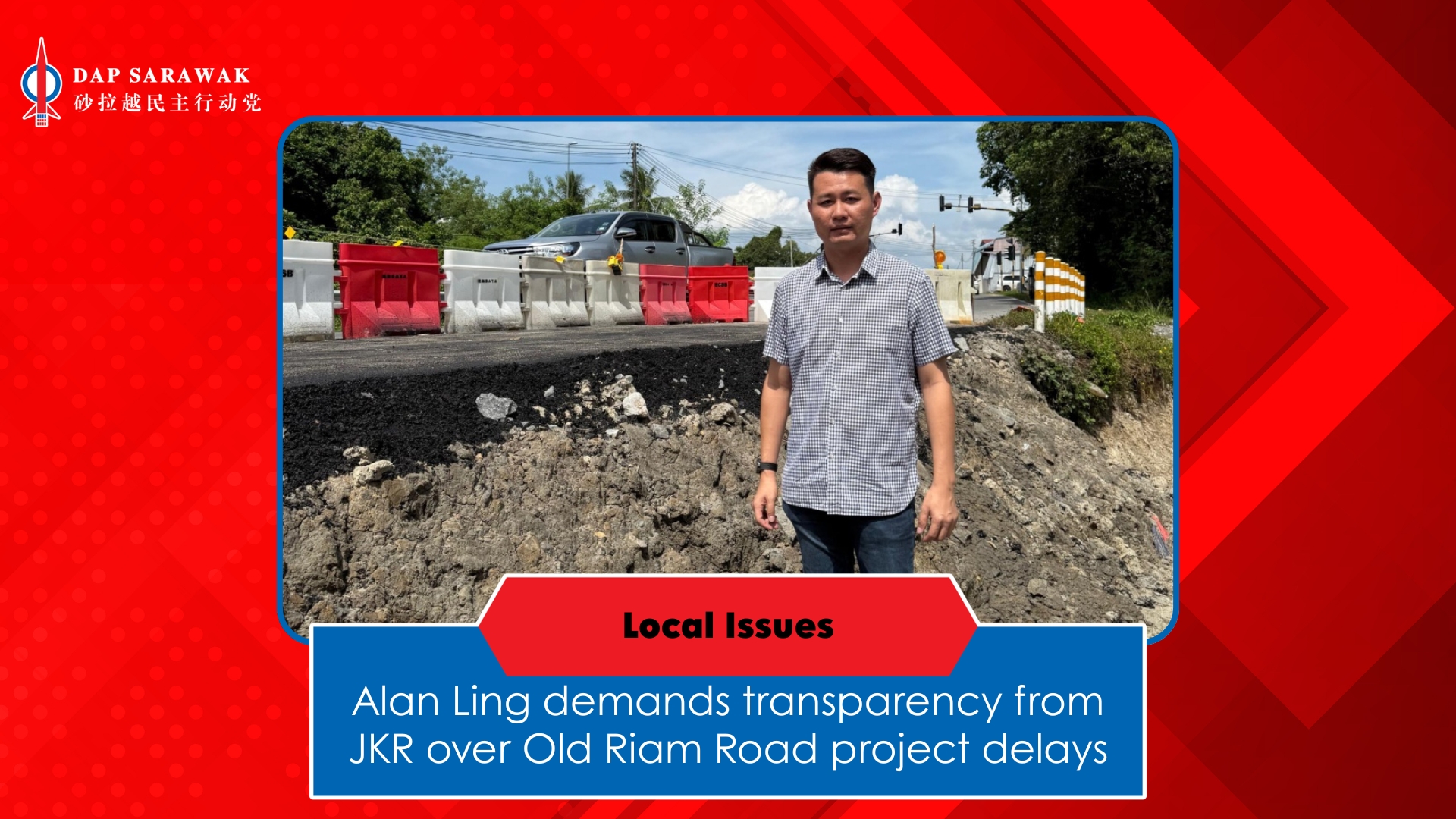
Miri: Sarawak Democratic Action Party (DAP) Secretary Alan Ling Sie Kiong has called on the Sarawak Public Works Department (JKR) to address serious management and oversight weaknesses, following ongoing delays and substandard repair works on Old Riam Road in Miri.
Emphasising the need for transparency and public accountability, Alan Ling urged JKR to publicly disclose the name of the contractor responsible for the subpar road resurfacing works as well as any penalties imposed after the project failed to meet quality standards.
“Any contractor incapable of meeting the basic standards of a simple asphalt resurfacing job should be immediately disqualified and blacklisted by JKR, barring them from participating in any future public infrastructure projects.
“This is necessary to safeguard public safety and protect taxpayers’ interests,” he said in a statement.
During his site visit, Alan Ling also discovered that although the road resurfacing work had been completed, roadside safety guardrails had not yet been installed, posing a serious safety hazard to road users.
“Particularly since this road section is located at a bend, safety guardrails are a critical feature and should have been installed concurrently or ahead of resurfacing works, not after.
“This leads to repeated work, inefficient use of public funds, and endangers road users’ safety,” he stressed.
He added that, through a follow-up inquiry via the Talikhidmat system, he was informed that while the road was officially repaired on June 24, the contractor’s work failed to meet required standards.
“As a result, JKR instructed the contractor to redo the work, causing prolonged delays in reopening the road to the public,” he said.
He pointed out that JKR bears the responsibility of supervising works comprehensively throughout the construction period, ensuring that projects meet all specifications and safety requirements, not merely conducting inspections after completion, discovering defects, and then ordering rework.
“Such practices result in unnecessary delays, wastage of resources, and inconvenience to the public,” he concluded.