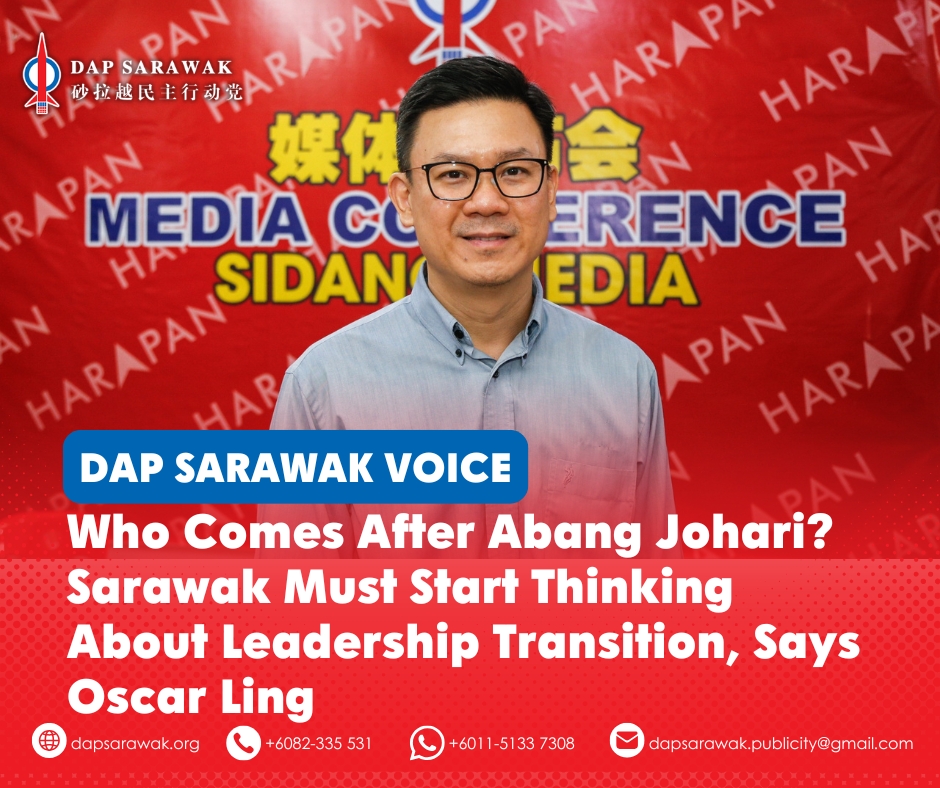
Sibu: Sarawak must start thinking seriously about its future leadership and political direction if Premier Tan Sri Abang Johari Tun Openg is preparing to lead Gabungan Parti Sarawak (GPS) for his final term, said Sibu MP Oscar Ling Chai Yew.
Ling said Abang Johari’s recent indication that the upcoming state election could be his final election, leading GPS signals that Sarawak is entering a new political phase, with questions now arising over who will eventually succeed him.
He said Sarawakians should not only focus on the next state election but also consider what kind of leadership and governance model should shape Sarawak after Abang Johari.
“A change in leadership is not merely about replacing the Premier. It concerns Sarawak’s future development philosophy, governance model and inter-ethnic relations,” he said in a statement today.
Ling said Sarawak’s strength lies in its diverse and inclusive society, which distinguishes it from the political environment in Peninsular Malaysia.
While respecting Abang Johari’s intention to step down eventually, he hoped his successor would preserve Sarawak’s multi-ethnic character rather than allow ethnic identity to become increasingly central to political and policy decisions.
He said greater representation from different ethnic groups, particularly Dayak leaders at the highest level, could better reflect Sarawak’s diverse political landscape and ease concerns over the growing ethnicisation of politics.
On the proposed 30% Bumiputera quota for major projects, Ling said the government should clarify its scope, implementation mechanism and beneficiaries.
He said helping the Bumiputera community was important, but quotas alone could not resolve long-standing economic challenges.
Instead, the government should strengthen education, skills training, entrepreneurship, financing, business management and market competitiveness.
“If projects or business opportunities are simply allocated according to ethnic proportions without simultaneously strengthening competitiveness, we may ultimately create an economic system that depends on quotas rather than genuinely developing competitive Bumiputera enterprises,” he said.
Ling warned that excessive emphasis on ethnic quotas could create dissatisfaction and division, stressing that assistance should ultimately be based on need and socio-economic circumstances.
He said Sarawak’s future leaders must build a more open and inclusive society where all communities can participate fairly in development and share in its benefits.