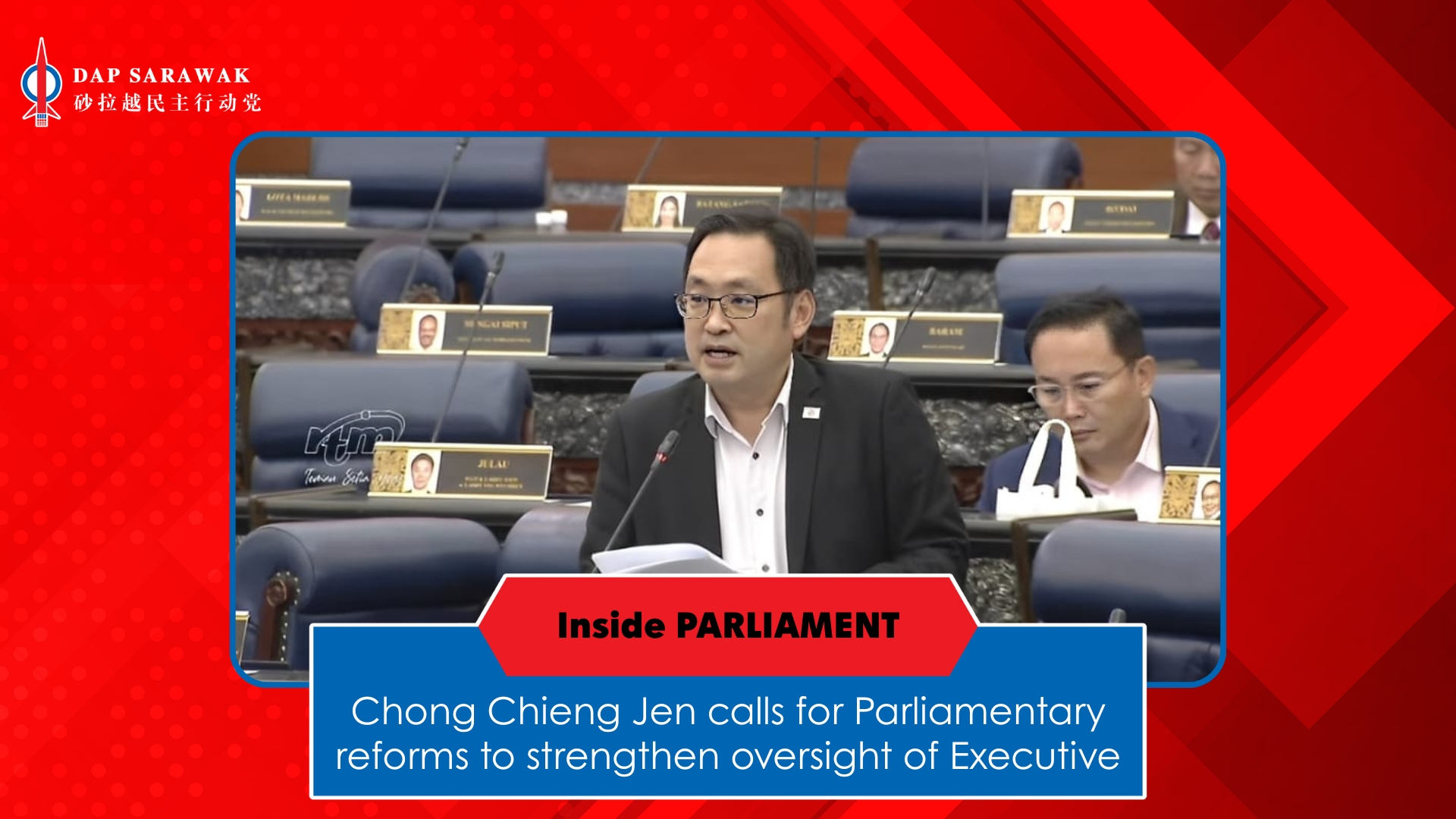
Kuala Lumpur: Stampin MP Chong Chieng Jen has called for parliamentary reforms aimed at enhancing oversight of the Executive and restoring public confidence in the transparency and integrity of the administration.
He said that over the years, Parliament’s oversight role has diminished, and to ensure good governance, there must be institutional checks and balances, especially in the exercise of Executive power.
“In our system, power is divided into three branches: the Legislature (Parliament), the Executive, and the Judiciary. In addition to forming the Executive, one of Parliament’s key roles is to provide oversight and scrutiny of the Executive.
“One of the proposed parliamentary reforms is to allow Special Select Committees to review the annual budget estimates before they are approved in Parliament,” he said during the debate on the 13th Malaysia Plan (RMK13) in the Dewan Rakyat yesterday.
Chong explained that the current committee stage of the budget debate is conducted in the Committee of the Whole House.
“Due to time constraints, the Speaker limits the number of MPs who can debate on each ministry and the time given for ministers to respond.
“No documentation or detailed records are produced during debates or ministerial responses. As a result, Parliament can only conduct a very superficial review of budget details before approval,” he said.
He proposed that during the committee stage of the budget debate, the operating and development expenditure estimates for each ministry should first be referred to a Special Select Committee for in-depth scrutiny before being brought back to the House for voting.
“In front of the Special Select Committee, information can be obtained from ministers and ministry officials on specific details.
“Evidence and feedback can be collected from external experts to review the expenditure breakdown, and MPs would have more time to debate each item in greater depth,” he said.
He added that once the Special Select Committee’s review is completed, the ministry’s budget would be referred back to the House along with the committee’s report and recommendations.
“There, the House would hold a short debate on the Supply Bill, the estimates, and the committee’s report,” he said.
He outlined the benefits of this proposed approach:
(i) It provides MPs a forum for in-depth, participatory and evidence-based review of the Budget before it is passed.
(ii) It provides MPs a forum to collate, discuss and narrow down proposals to improve the Budget within a fixed time frame.
(iii) It does not pose a challenge to the government’s mandate of confidence, as a committee’s recommendations are not considered an indication of no confidence.
(iv) The government and parliamentary majority are not compelled to accept committees’ recommendations, as they will still be subject to a vote in the House.
(v) It elevates Malaysia’s budget process to the equivalent of those in advanced Westminster parliaments like the UK, Australia, New Zealand, Canada and India.