
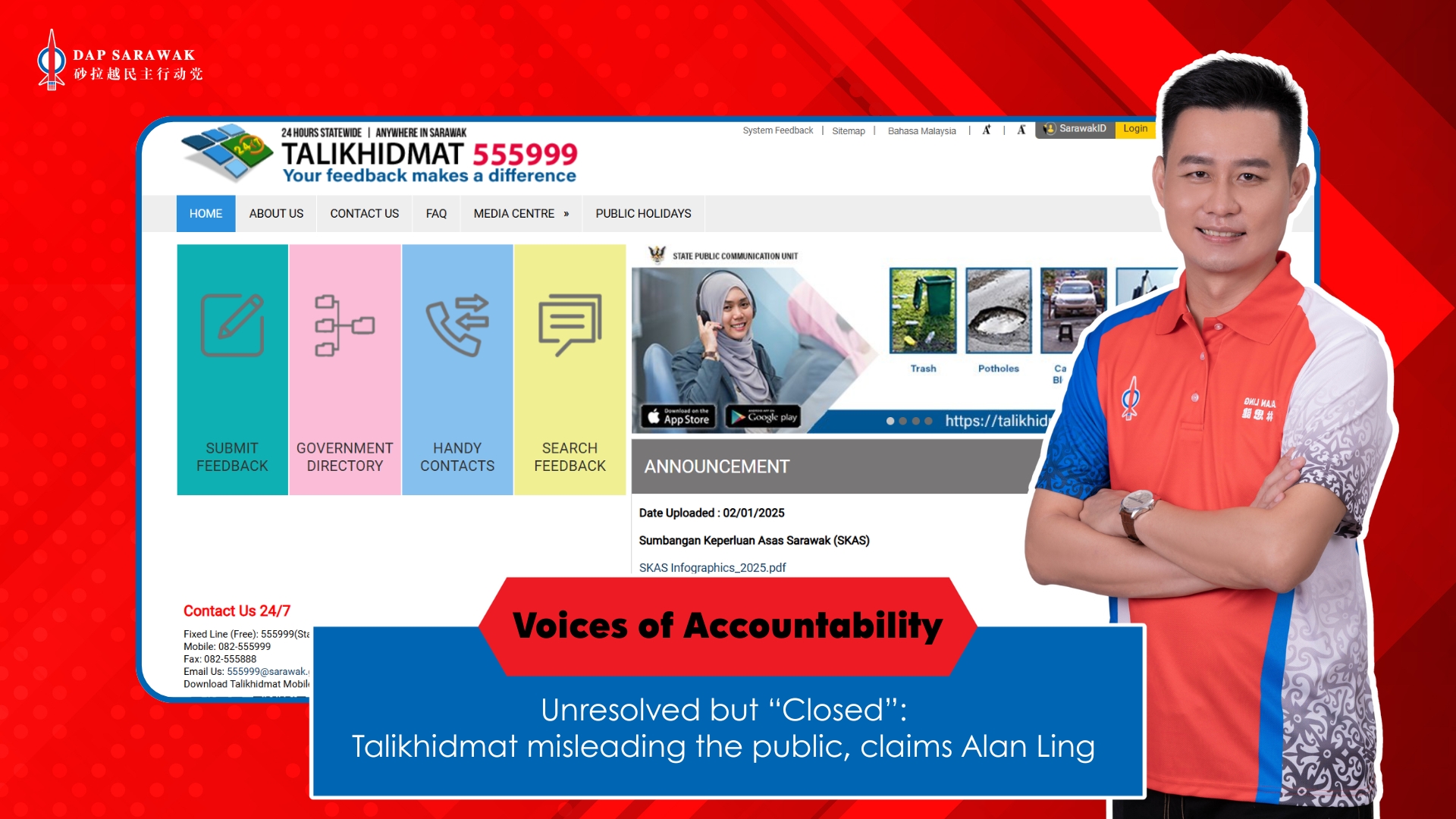
Miri: The Democratic Action Party (DAP) Sarawak Secretary, Alan Ling Sie Kiong, has strongly criticised the state’s integrated public complaint platform, Talikhidmat, calling it a failed mechanism that frustrates users instead of resolving their issues.
Originally established under the Premier’s Department to streamline public complaints and channel them efficiently to the relevant government agencies, Talikhidmat is now facing scrutiny for what Ling described as poor implementation and a lack of accountability.
“Talikhidmat’s initial concept was commendable, but the execution has been dismal. It has become a hollow and ineffective system that does little more than give the illusion of action,” he said.
One of the main issues, Ling explained, is the platform’s tendency to prematurely mark cases as “closed” despite no tangible progress or response from the agencies involved. He warned that this practice undermines the system’s credibility and defeats the platform’s intended purpose.
“Complaints that haven’t been resolved should remain under Keep In View (KIV) status,” he stressed. “Prematurely closing files forces the public to submit new reports for the same unresolved issues. This not only causes unnecessary administrative duplication but creates confusion and inefficiency.”
Citing a recent example, Ling pointed to a complaint regarding landslide risks in the area behind the Lai Pau Garden residential area. Although Talikhidmat referred the case to the Sarawak Disaster Management Committee, which responded that it was awaiting funding, the case was still marked as “closed” with no further action taken.
“This kind of administrative handling only erodes public trust,” said Ling, adding that the platform’s closure-centric approach appears to prioritise “attractive statistics” over actual outcomes.
He condemned what he described as an “ostrich mentality” in handling complaints – burying issues instead of addressing them and warned that such practices could lead to deeper systemic failures hidden behind polished metrics.
Ling urged Talikhidmat to conduct a comprehensive review of its complaint management process and to restore its original mission of transparency, accountability, and public service.
“A complaint platform should never be a tool for bureaucratic window-dressing,” he concluded. “The public deserves real solutions, not superficial answers.”