
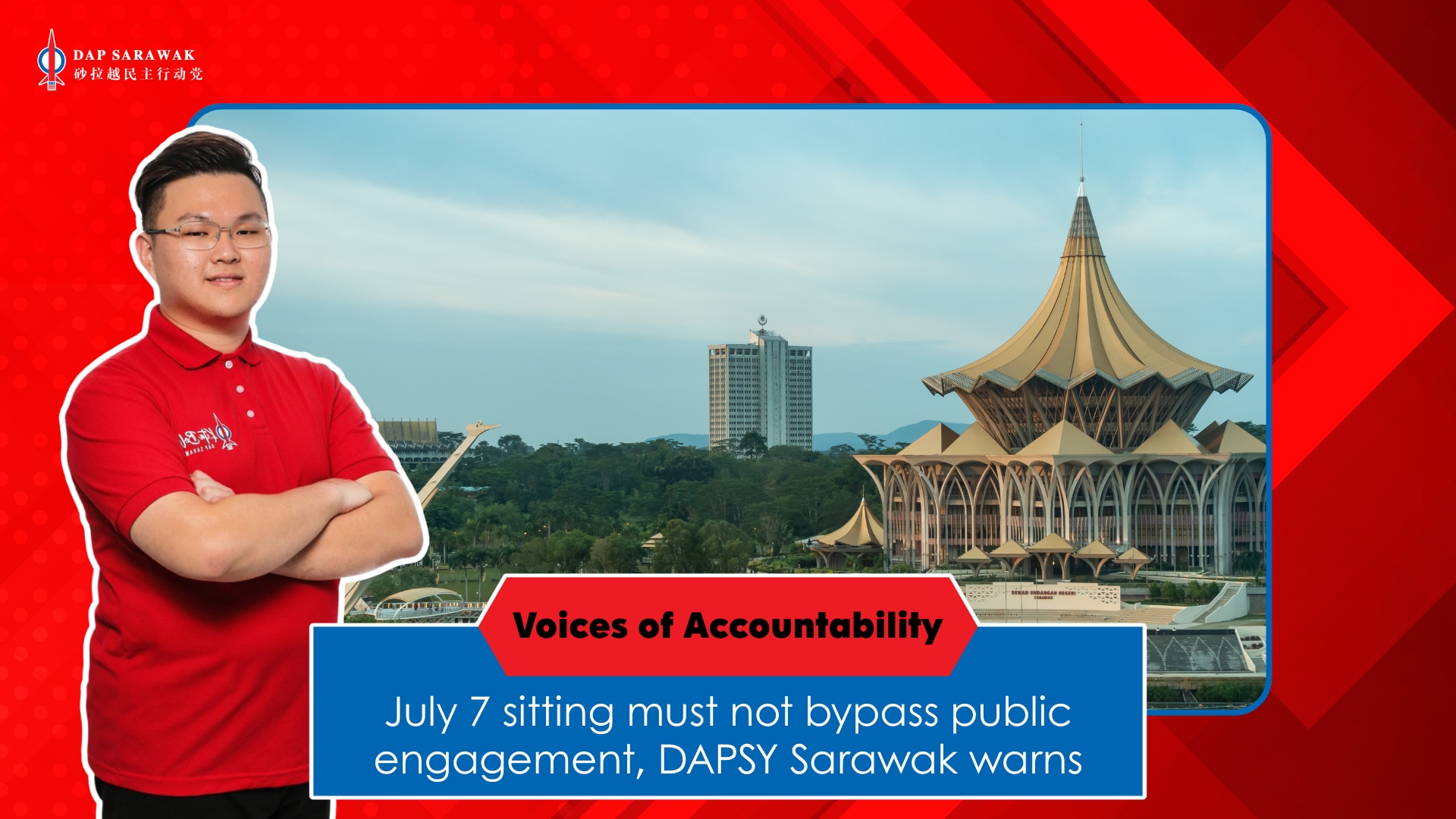
Kuching: As the Sarawak State Legislative Assembly prepares to convene a special one-day sitting on July 7, a strong call has emerged for the state government to immediately disclose the full agenda amid growing speculation that significant constitutional amendments and electoral boundary changes may be in the pipeline.
DAP Socialist Youth (DAPSY) Sarawak Secretary George Lam is urging the state government to make public any plans, stressing that early disclosure is crucial to ensure meaningful public engagement and scrutiny.
“That is why I am calling on the Sarawak Government to promptly disclose the full agenda of the upcoming July 7 special sitting.
“Any proposed constitutional amendments or redelineation plans should be made public early, so that state assemblyman/women, the media, civil groups, and voters have enough time to analyse and respond,” Lam said in a statement.
The statement follows widespread reports that the sitting may include amendments to the Sarawak Constitution and a new round of electoral boundary redelineation.
Lam emphasised that transparency in this process is not merely a matter of parliamentary courtesy but a fundamental democratic responsibility.
“This is not just about respecting parliamentary procedures. It is about safeguarding the fundamental rights of every voter in Sarawak,” he said.
Under the Federal Constitution, electoral redelineation is supposed to take place every eight years. The last such exercise in Sarawak was conducted between 2015 and 2016, which saw an increase in state constituencies from 71 to 82 seats. Eight years have now passed, and in 2023, the Election Commission had already begun the technical and legal groundwork for a new round of redelineation.
Based on established legal procedures, the Sarawak State Assembly must first amend the State Constitution to allow for an increase in seats. Once this is done, the Election Commission (SPR) will be empowered to redraw constituency boundaries based on the new seat count. These proposed boundaries would then be submitted to Parliament for approval, and upon gazettement, would take effect in the next state election.
Lam raised concerns about representation imbalances, particularly in fast-growing urban areas such as Kuching, Miri, and Sibu, where constituency sizes have failed to keep pace with population growth.
This, he said, has diluted the voting power of urban residents relative to voters in sparsely populated rural areas.
He argued that any redelineation must correct these disparities and move Sarawak toward the principle of “one person, one vote, equal value.”
“I sincerely hope that this process will be treated as an opportunity to strengthen Sarawak’s democratic foundation by ensuring a fair, representative, and balanced distribution of seats – one that truly reflects our population,” Lam said.
He also called on the Election Commission to carry out the redelineation professionally and independently, with full public consultation and transparency, warning against any attempt to manipulate the process for political gain.